
Programmable Pore Environments in Multivariate ZIF Membranes for Ultra-Selective Helium Recovery from Natural Gas
Yang Liu1,2,3, Teng Li1,2,3, Ziwen Fan1,2,3, Wenjing Lv1,2,3, Yining Liao1,2,3, Zhenggong Wang(王正宫)1,2,3*, Michael D. Guiver4, Daniel Maspoch5,6,7,8*, Jian Jin1,2,3(靳健)*
1State Key Laboratory of Bioinspired Interfacial Materials Science, Soochow University, Suzhou 215123, P. R. China
2College of Chemistry, Chemical Engineering and Materials Science & Jiangsu Key Laboratory of Advanced Functional Polymer Materials, Soochow University, Suzhou 215123, P. R. China
3Jiangsu Key Laboratory of Advanced Functional Polymer Materials, Soochow University, Suzhou 215123, P. R. China
4State Key Laboratory of Engines, School of Mechanical Engineering, Tianjin University, Tianjin 300072, China
5Catalan Institute of Nanoscience and Nanotechnology (ICN2), CSIC, Bellaterra 08193, Spain
6The Barcelona Institute of Science and Technology, Bellaterra 08193, Spain
7Departament de Química, Universitat Autònoma de Barcelona (UAB), Cerdanyola del Vallè, Bellaterra 08193, Spain
8ICREA, Pg. Lluís Companys 23, Barcelona 08010, Spain
J. Am. Chem. Soc. 2026, 148, 9910–9919
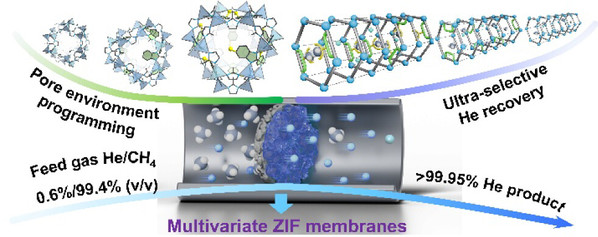
Abstract: Helium is an essential yet finite resource with critical applications in medical imaging and semiconductor manufacturing, whose production currently relies almost exclusively on energy-intensive cryogenic separation of trace helium from natural gas. Membrane-based separations offer an attractive alternative, but existing materials lack the selectivity required for industrial deployment. Here, we introduce a strategy for pore microenvironment programming in multivariate zeolitic imidazolate framework (MTV-ZIF) membranes, enabling ultraselective helium recovery under realistic feed gas conditions. By precisely combining Zn2+, 2-methylimidazole, and halogen-substituted benzimidazole linkers, we create synergistic combinations of steric constraints and enhanced CH4–framework interactions, which collectively suppress CH4 transport while preserving rapid He permeation. Under simulated industrial feed conditions (0.6% He/99.4% CH4 by volume), the best-performing membrane delivered a record He/CH4 selectivity of 3174, with stable operation over 960 h. Process simulations further show that a two-stage membrane cascade can deliver >99.95% He purity with an 83% reduction in energy demand compared to cryogenic distillation. These results highlight multivariate pore programming in MOFs as a powerful platform for efficient, low-energy He recovery from natural gas.
Article information: https://doi.org/10.1021/jacs.5c22294