
Precise Design of Hydrogels by Machine Learning-Assisted Solvent Exchange Strategy
Ma Longyu1,2, LiWenjing1, Li Zipei1, Qian Jiaxuan1, Zhao Chihao2, WuYan2, He Hanliang(何罕亮)3*, Jin Guoqing(金国庆)4*, Zhu Jian1, Pan Xiangqiang(潘向强)1*, Zhang Zhengbiao(张正彪)1*
1State and Local Joint Engineering Laboratory for Novel Functional Polymeric Materials, Jiangsu Key Laboratory of Advanced Functional Polymer Design and Application, College of Chemistry, Chemical Engineering and Materials Science, Soochow University, Suzhou 215123, China
2College of Life Science, Mudanjiang Medical University, Mudanjiang 157011, China
3The Department of Orthopedic Surgery, the Fourth Affiliated Hospital of Soochow University, Suzhou 215005, China
4School of Mechanical and Electric Engineering, Soochow University, Suzhou 215006, China
Macromolecules 2026, 59, 1873-1884
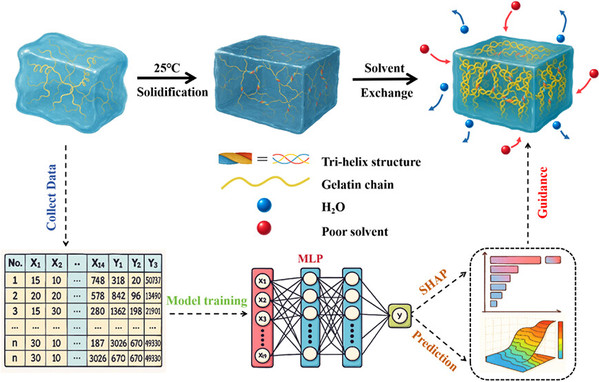
Abstract: Hydrogels have attracted significant attention in the field of biomedical materials due to their excellent biocompatibility and tunable network structures. However, the rational design of hydrogel systems remains a formidable challenge, as it is difficult to precisely predict or control their performance. Traditional trial-and-error approaches are inefficient and often lack mechanistic interpretability, underscoring the need for effective predictive tools to enable targeted formulation–property mapping. The solvent displacement method, by regulating the spatiotemporal expression of intra and interpolymer interactions, provides a versatile route to prepare hydrogels with superior toughness and antiswelling performance. This process involves the synergistic influence of multiple parameters, including polymer concentration, solvent physicochemical properties, and processing conditions. In this work, we propose a machine learning-assisted design framework tailored for small-sample scenarios, focusing on gelatin-based hydrogels fabricated via the solvent displacement method. Utilizing approximately 200 experimental samples, we trained a multilayer perceptron (MLP) model integrated with Bayesian optimization to achieve accurate prediction of key performance metrics. To gain mechanistic insight, SHAP analysis was employed to quantify the contributions of individual variables and elucidate their impact on storage modulus, loss modulus, and hydrogel viscosity. The trained model was subsequently used for large-scale virtual screening of hydrogel formulations, resulting in the construction of a performance database comprising tens of thousands of data entries. This work demonstrates that even with limited experimental input, the integration of data-driven approaches enables efficient identification of design principles in solvent–displacement hydrogel systems, providing a quantitative foundation for on-demand formulation and offering new directions for the intelligent development of multicomponent, multifunctional hydrogels.
Article information: https://doi.org/10.1021/acs.macromol.5c02582