
Selective CO Homologation to Acyclic [CnOn]2– (n = 2–4) Motifs through Mg/Ni Cooperative Strategy
ChenMin1,2,RajeshkumarThayalan3,4,Cai, Yanping(蔡艳苹)1,2*,Maron, Laurent3,4*,Xu, Xin(徐信)1,2*
1State Key Laboratory of Bioinspired Interfacial Materials Science, College of Chemistry, Chemical Engineering and Materials Science, Soochow University, Suzhou 215123, P. R. China
2Key Laboratory of Organic Synthesis of Jiangsu Province, College of Chemistry, Chemical Engineering and Materials Science, Soochow University, Suzhou 215123, P. R. China
3LPCNO, CNRS, Université Paul Sabatier, 135 Avenue de Rangueil, Toulouse 31077, France
4INSA, Université Paul Sabatier, 135 Avenue de Rangueil, Toulouse 31077, France
Inorg.Chem. 2026, 65, 4633−4640
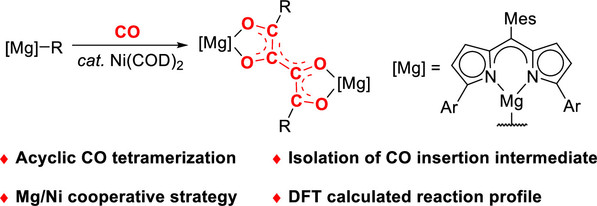
Abstract: Reductive homologation of carbon monoxide (CO) serves as a pivotal process in C1 chemistry, mimicking the chain-growth mechanisms of industrial Fischer–Tropsch synthesis. Herein, the nickel-catalyzed selective homologation of CO with dipyrromethene ligand supported magnesium alkyl compounds through a Mg/Ni cooperative strategy is reported. Reaction of magnesium alkyl compounds L1MgR·Et2O [L1 = 1,9-di(isopropylphenyl)-5-mesityldipyrromethene; R = nBu, Et] with CO (1 bar) in the presence of 20 mol % Ni(COD)2 (COD = 1,5-cyclooctadiene), selectively yielded the acyclic CO tetramerization products (L1Mg)2(μ-C4O4)R2. By tuning the steric hindrance of the ancillary ligands, the reaction pathways can be directed to form the linear CO trimerization compound (L2Mg)2(μ-C3O3)nBu2 (L2 = 1,5,9-trimesityldipyrromethene) and the CO dimerization compound(L3Mg)2(μ-C2O2)nBu2 [L3 = 1,9-di(1-adamantyl)-5-mesityldipyrromethene], respectively. Moreover, the Mg/Ni-cooperative CO insertion species [L2Mg(CO)nBu]3[Ni4(CO)7] was isolated from the stoichiometric reaction of L2MgnBu·Et2O with Ni(COD)2 under a CO atmosphere. This species further reacted with CO to form the trimerization product (L2Mg)2(μ-C3O3)nBu2, confirming its active role in the CO homologation process. The formation mechanism of the acyclic CO tetramerization compound was elucidated by density functional theory calculations, which mainly involved the CO insertion, C–C coupling, and carbene dimerization processes, verifying the critical role of the Mg/Ni cooperative strategy in the reaction.
Article information: https://doi.org/10.1021/acs.inorgchem.5c05821