
Manipulating Molecular Configurations of Organic Charge-Transfer Cocrystals with Programmable Near-Infrared Emission for Dual-Emission Optical Waveguide
Zhao Yu-Dong1, Wu Bin1, LuHang2, Shi Ying-Li3, Zhuo Sheng4, Luo Peng1, Xue Yang-Biao2, Su Yang1, Zheng Min2, Wang Zuo-Shan(王作山)1*, Zhuo Ming-Peng(卓明鹏)2*, Wang, Xue-Dong(王雪东) 5*
1College of Chemistry, Chemical Engineering and Materials Science Soochow University, Suzhou 215123, China
2National Engineering Laboratory for Modern Silk, College of Textile and Clothing Engineering Soochow University, Suzhou 215123, China
3Department of Electrical and Electronic Engineering, Xi’an Jiaotong-Liverpool University, Suzhou 215123, China
4State Key Laboratory of Coordination Chemistry, College of Engineering and Applied Sciences, Nanjing University, Nanjing 210023, China
5Institute of Functional Nano & Soft Materials (FUNSOM), Jiangsu Key Laboratory for Carbon Based Functional Materials & Devices, Soochow University, Suzhou 215123, China
ACS Nano,2026, 20, 8622–8633
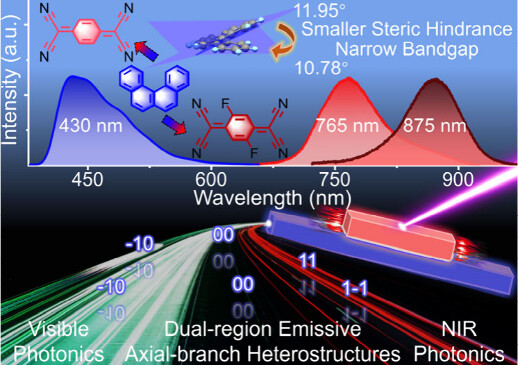
Abstract: Molecular engineering in molecular configuration was successfully applied to finely design the advanced organic semiconductors. However, it has rarely been investigated in organic charge-transfer (CT) cocrystals with desired optoelectronic properties that could be controllably prepared via a facile self-assembly process. Herein, the organic benzo[c]phenanthrene (BcP)-based CT cocrystals with a programmable near-infrared (NIR) emission peak beyond 760 nm were rationally designed via manipulating the BcP molecular skew angle for an anisotropic packing mode. Notably, the torsional distortion of BcP molecule induced by CT interaction leads to a reduced dihedral angle from 11.95° to 10.78° for a minimized steric hindrance, showing a NIR emission red-shifted to 875 nm. Furthermore, these NIR cocrystals with high chemical/structural compatibility were purposefully integrated into the organic axial-branch heterostructure by adjusting CT interaction intensity in the horizontally epitaxial-growth process, which demonstrates a tunable spatial exciton conversion and dual-emission optical waveguide for optical logic gate. This confinement-assisted CT modulation strategy presents a versatile route to high-performance NIR emitters and hierarchical heterostructures for integrated optoelectronics applications.
Article information: https://doi.org/10.1021/acsnano.5c20905