
Optimizing Redox Centers Distribution in Benzothiadiazole-Based Polymers for High-Efficiency H2O2 Photosynthesis in Pure Water
Qiuyuan Ren1, Xueqing Li2, Menglong Li1, Juanzhang Ruan1, Shihong Dong3, Najun Li1, Qingfeng Xu1, Hua Li1, Dongyun Chen1(陈冬赟)*, Jianmei Lu1(路建美)*
1State Key Laboratory of Bioinspired Interfacial Materials Science, College of Chemistry, Chemical Engineering and Materials Science, Collaborative Innovation Center of Suzhou Nano Science and Technology, Soochow University, Suzhou 215123, P. R. China
2School of Textile, Clothing and Materials, Shazhou Professional Institute of Technology, Zhangjiagang, Jiangsu 215600, P. R. China
3Suzhou Shijing Technology Co., LtdSuzhou 215137, P. R. China
Adv. Funct. Mater. 2025, 36,e21077
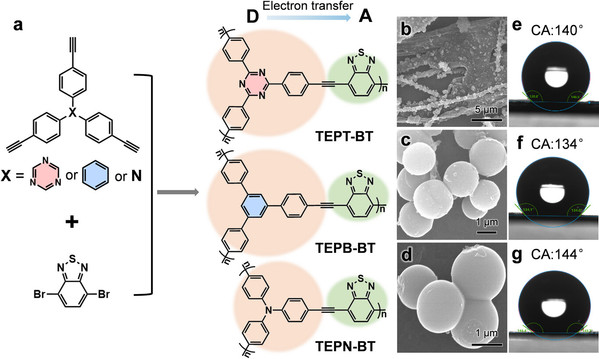
Abstract: Hydrogen peroxide (H2O2) photosynthesis by two-electron oxygen reduction reaction (ORR) is a promising eco-friendly approach. However, some intrinsic limitations of photocatalytic materials and constrained reaction environments hinder the improvement of catalytic performance. Conjugated polymer materials are widely studied as photocatalysts owing to their diverse building blocks and tunable electronic structures. In this study, hydrophobic benzothiadiazole (BT)-based conjugated polymers with donor–acceptor (D–A) structures, namely TEPT-BT, TEPB-BT, and TEPN-BT, are designed by changing the donor molecular center. In a pure water/air environment with TEPT-BT, H2O2 is efficiently produced at a rate of 2540.2 µmol g−1 h−1. Density functional theory calculation results revealed that the triazine ring of 2,4,6-tris(4-ethynylphenyl)-1,3,5-triazine (TEPT) served as an additional electron acceptor other than BT. This feature endows TEPT-BT with an optimal arrangement of redox centers, thereby enhancing exciton separation efficiency. Moreover, the triazine ring functioned as a powerful oxygen (O2) adsorption site to promote H2O2 photosynthesis under the synergistic effect of asymmetric dual ORR active sites. This study offers a promising approach for designing new hydrophobic D–A type conjugated polymer photocatalysts.
Article information: https://doi.org/10.1002/adfm.202521077