
Flexible Fluorine/Nitrogen Co-Doped Carbon Electrodes with Silver Nanowire Reinforcement Enable Ultralong-Cycling Lithium-Ion Batteries
Junjie Fu1, Xu Han1, Xueming Su1, Ziling Huang1, Xiaoquan Yang1, Lin Luo1, Xueqin Cao1, Jian-Ping Lang1,2,3(郎建平)*, Hongwei Gu1(顾宏伟)*
1College of Chemistry Chemical Engineering and Materials Science Soochow University Suzhou, Jiangsu 215123, P. R. China
2State Key Laboratory of Organometallic ChemistryShanghai Institute of Organic ChemistryChinese Academy of Sciences,Shanghai 200032, P. R. China
3State Key Laboratory of Coordination ChemistrySchool of Chemistry and Chemical EngineeringNanjing UniversityNanjing 210023, P. R. China
Adv. Funct. Mater. 2026, 36, e14737
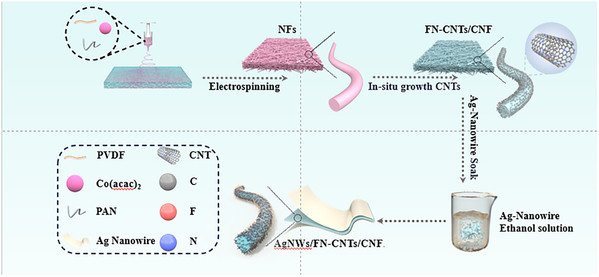
Abstract: The growing demand for flexible electronic devices necessitates power sources that combine high energy density with robust mechanical stability. While in situ growth techniques mitigate the detachment of active materials from flexible substrates, mechanical fatigue—such as cracking and delamination under repeated deformation—continues to limit electrode durability and cycle life. To address these challenges, the design of a self-supporting, binder-free flexible electrode (AgNWs/FN-CNTs/CNF) (CNT=carbon nanotube; CNF=carbon nanofiber) is reported that integrates silver nanowires (AgNWs) as both internal fillers and external coatings. This dual-surface reinforcement strategy enhances the electrode's structural integrity, enabling ultra stable cycling over 10 000 cycles at 5 A g−1 with a specific capacity of 112 mAh g−1. Furthermore, fluorine and nitrogen co-doping effectively enlarges the interlayer spacing of graphitic domains, facilitating lithium-ion diffusion and improving rate capability. Flexible pouch cell tests demonstrate the mechanical resilience and stable electrochemical performance of the electrode under repeated deformation. This work presents a scalable and efficient approach for enhancing the mechanical and electrochemical stability of flexible electrodes, offering design principles for the development of next-generation high-performance flexible energy storage devices.
Article information: https://doi.org/10.1002/adfm.202514737