
Perspective on Polymer Membranes for Hydrogen and Carbon Dioxide Separation
Lele Guo1,2, Wenjing Lv1,2, Yuting Wang1,2, Yu Jiao1,2, Zhenggong Wang1,2,3,4(王正宫)*, Jian Jin1,2,3(靳健)*
1State Key Laboratory of Bioinspired Interfacial Materials Science, Soochow University, Suzhou 215123, China
2College of Chemistry, Chemical Engineering and Materials Science, Soochow University, Suzhou 215123, China
3Jiangsu Key Laboratory of Advanced Functional Polymer Materials, Soochow University, Suzhou 215123, China
4Jiangsu Key Laboratory of Advanced Negative Carbon Technologies, Soochow University, Suzhou 215123, China
Macromolecules 2026, 59, 29–49
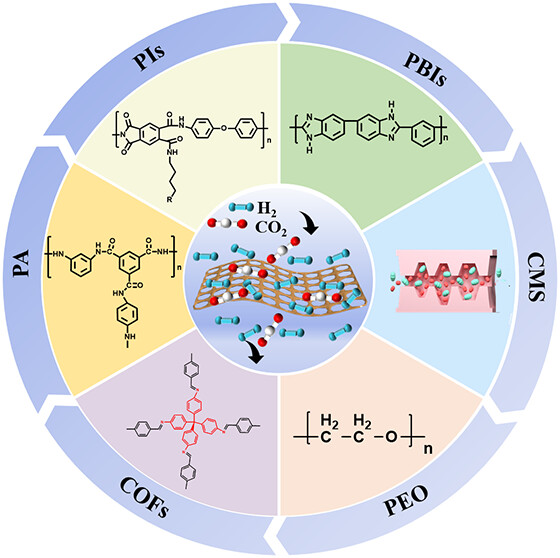
Abstract: The efficient separation of hydrogen (H2) and carbon dioxide (CO2) mixtures represents a critical step in clean H2 production, where environmentally friendly and energy-saving membrane technology serves as a promising solution. The key to realizing practical applications of membrane separation technology lies in the rational design and development of polymeric membrane materials that simultaneously exhibit high permeability and high selectivity. However, polymeric membrane materials face challenges in efficiently separating H2 and CO2 with similar molecular sizes. This review systematically summarizes recent research progress in polymeric membrane materials for H2 and CO2 separation. It focuses on analyzing the characteristics and separation performance of various material systems, including poly(ethylene oxide) (PEO), polyimides (PIs), polybenzimidazoles (PBIs), carbon molecular sieve membranes (CMSMs), polyamides (PAs) and polyarylates (PARs), and covalent organic framework (COF) membrane. The review thoroughly discusses current key challenges and technical bottlenecks of polymer membranes for hydrogen and carbon dioxide separation, while also providing insights into future development directions.
Article information: https://doi.org/10.1021/acs.macromol.5c01684