
Halogen Substituent Engineering in the Quinoxaline-based Central Unit of Acceptor for Efficient Organic Solar Cells
Jun Feng, Ya Yuan, Hang Yang, Yu Tao, Kewei Hu, Kui Li, Jiahao Qian, Jianlong Hu, Xuncheng Zhu, Yue Wu, Chaohua Cui(崔超华)*
Laboratory of Advanced Optoelectronic Materials Suzhou Key Laboratory of Novel Semiconductor Optoelectronics Materials and Devices State Key Laboratory of Bioinspired Interfacial Materials Science, College of Chemistry Chemical Engineering and Materials Science Soochow, University Suzhou 215123, China
Adv. Funct. Mater.2026,36,e11955
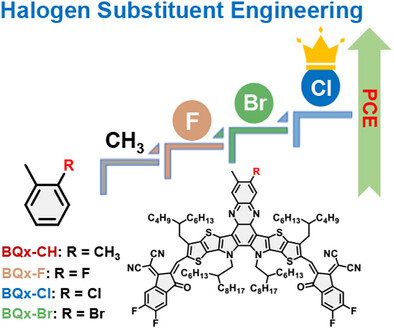
Abstract: The quinoxaline (Qx)-based central core in A-DA′D-A (A = acceptor unit, D = donor unit)-type small molecules featured small ring tension, restricted free bond rotation, and several modification sites, which are desirable for designing high-performance acceptor materials. Therefore, the rational molecular optimization conducted on Qx-based central core plays a pivotal role in modulating the physicochemical properties of photovoltaic materials. This work demonstrates the significance of halogen substituents on the Qx-based core of A-DA′D-A-type acceptors in tuning the physicochemical and photovoltaic properties. Relative to the BQx-CH with methyl group substituent on Qx-based core, the halogen substituent engineering effectively regulates the molecular aggregation and stacking to match with the polymer donor D18. As a result, the BQx-Cl-based device demonstrates a significantly higher power-conversion efficiency (PCE) of 15.74% compared with the D18:BQx-CH-based device with a PCE of 8.90%. In addition, BQx-Cl shows encouraging capability in serving as a guest material to improve the photovoltaic performance of D18:BTP-eC9-based device. The D18:BTP-eC9:BQx-Cl-based ternary device without any treatment yields a notable PCE of 19.81%, which is a significant improvement with regard to the PCE of 18.21% for the D18:BTP-eC9-based binary device.
Article information: https://doi.org/10.1002/adfm.202511955