
Cyclodextrin-functionalized Ag/AgCl foam with enhanced photocatalytic performance for water purification
Haiguang Zhu, Dongyun Chen *(陈冬赟), Najun Li, Qingfeng Xu, Hua Li, Jinghui He, Jianmei Lu *(路建美)
Collaborative Innovation Center of Suzhou Nano Science and Technology College of Chemistry Chemical Engineering and Materials Science, Soochow University, 199 Ren’ai Road, Suzhou 215123, PR China
Journal of Colloid and Interface Science 531 (2018) 11–17
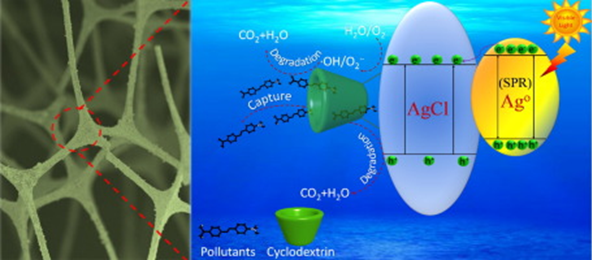
The application of visible light-induced photocatalysts for photocatalytic pollution mitigation has become a promising strategy due to the inexhaustible solar energy. And how to improve pollutants degradation rate is still a meaningful work. Many researchers dealt with this issue by enhancing visible light absorption of photocatalysts. However, few studies focus on this issue by improving semiconductor’s absorption property of organic pollutants. Hence, in this work, we prepared the Ag/AgCl foam coated per-6-thio-β-cyclodextrin (SH-β-CD) to improve the photocatalytic activity of Ag/AgCl foam. Here, we chose SH-β-CD because it has a special cavity that can effectively absorb and capture proper organic pollutants via host-guest interaction, which makes it an ideal pollutants surface adsorber when coated on the surface of Ag/AgCl particles. Hence, those trapped pollutants in the cavities can be attacked directly by those reactive oxidation species (ROS) that produced by Ag/AgCl particles under visible light irradiation, resulting in the significant promotion of pollution mitigation rate. The experimental results demonstrated the photodegradation rate constant of methyl orange (MO) by Ag/AgCl@β-CD foam (k = 0.120 min−1) increased approximately 2.6 times compared with pure Ag/AgCl from (k = 0.048 min−1). We anticipate our SH-β-CD modified Ag/AgCl foam would be a promising candidate for photodegradation of organic pollutants in wastewater remediation.
链接:https://www.sciencedirect.com/science/article/pii/S0021979718308026?via%3Dihub