
Bimetallic-Tetrathiafulvalene Metal–Organic Frameworks: Finely Tailoring Crystal Morphologies and Enhancing Positrode Performance of Supercapatteries
Zi-Yi Wang, Jun-Die Zhang, Wei Liu, Zhou-Hong Ren, Qin-Yu Zhu(朱琴玉)*
College of Chemistry, Chemical Engineering and Materials Science, Soochow University, Suzhou 215123, P. R. China
Inorg. Chem.2025, 64, 48, 23708–23716
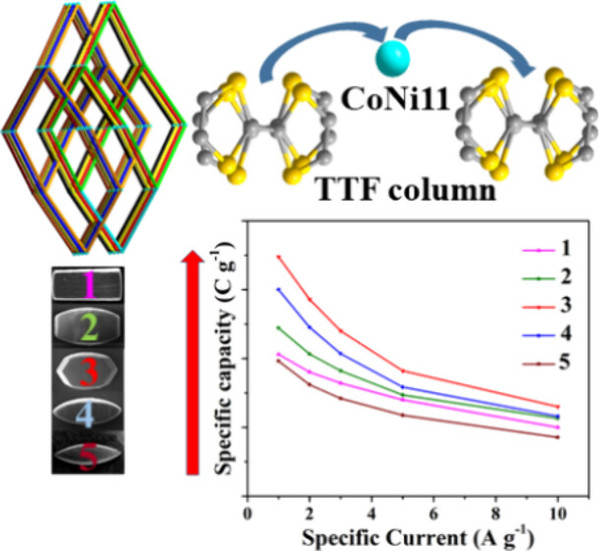
Abstract: Integrating mixed-metal ions and redox-active ligands into bimetal–organic frameworks (BMOFs) represents a promising yet relatively underexplored strategy for enhancing positrode performance in emerging supercapatteries. This work presents a series of isostructural monometal–organic frameworks (MMOFs,1 and5) and BMOFs (2,3, and4) with varying Co(II)/Ni(II) ratios and a redox-active tetrathiafulvalene (TTF) ligand. MOFs1–5 exhibit a high-density three-dimensional 8-fold interpenetrating diamond-like topology. Competitive coordination from secondary metal ions enables unprecedented systematic control over the crystal morphology. Combined experimental and theoretical analyses reveal enhanced conductivity resulting from synergistic interactions between mixed-metal ions and the TTF ligand, with the Co/Ni 1:1 ratio (MOF3) exhibiting optimal electron transport. Notably, iodine-treated BMOF3 (3-ox) achieves a specific capacity of 884.3 C g–1 at 1 A g–1. The AC||3-ox supercapattery delivers a specific energy of 91.8 Wh kg–1 at 0.97 kW kg–1, surpassing that of other CoNi-MOF-based electrodes. The device retains 87.5% of its capacity after 10,000 cycles. This work proposes a novel strategy for designing MOF-based supercapattery electrodes using BMOFs with redox-active ligands, which diverges from conventional metal-centric approaches to achieve targeted electrochemical performance.
Article information: https://doi.org/10.1021/acs.inorgchem.5c04588