
Modular Synthesis of ABAC-Type Periodic Terpolymers via RAFT Single-Unit Monomer Insertion and RAFT Step-Growth Polymerization
Qing Li1, Jiajia Li1(李佳佳)*, Joji Tanaka2, Xiaofeng Pan1, Samantha Marie Clouthier2, Xiangqiang Pan1, Zhengbiao Zhang1, Wei You2(尤为)*, Jian Zhu1(朱健)*
1State Local Joint Engineering Laboratory for Novel Functional Polymeric Materials, Jiangsu Key Laboratory of Advanced Functional Polymer Design and Application, Suzhou Key Laboratory of Macromolecular Design and Precision Synthesis, Department of Polymer Science and Engineering, College of Chemistry Chemical Engineering and Materials Science, Soochow University, Suzhou 215123, China
2Department of Chemistry, University of North Carolina at Chapel Hil, Chapel Hill, North Carolina 27599, United States
Macromolecules2025, 58, 23, 12756–12764
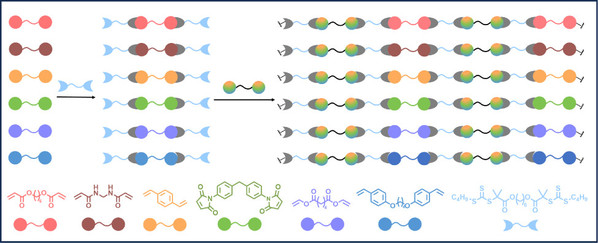
Abstract: Precise control over monomer sequence in synthetic polymers remains a central challenge in polymer chemistry, with significant implications for materials design and controlled degradation. Here, we report a modular and efficient strategy for synthesizing ABAC-type periodic terpolymers by integrating reversible addition–fragmentation chain transfer single-unit monomer insertion (RAFT-SUMI) with RAFT step-growth polymerization. Sequence-regulated oligomers are first constructed via RAFT-SUMI using bifunctional RAFT agents and vinyl monomers, then employed as bifunctional RAFT agents for step-growth polymerization with complementary vinyl monomers. The method enables precise control over polymer sequence and architecture, affording terpolymers with tunable molecular weights and thermal properties. A broad library of ABAC-type terpolymers was synthesized, exhibiting glass transition temperatures (Tg) from −28.75 to 79.75 °C and decomposition temperatures (Td) from 194.9 to 243.64 °C. Incorporation of disulfide linkages into the polymer backbone further enabled selective degradation in response to chemical stimuli, confirming the periodic nature of the sequence. This work establishes a generalizable platform for constructing precision macromolecules with programmable functionality, offering broad potential for applications in degradable materials and advanced polymer systems.
Article information: https://doi.org/10.1021/acs.macromol.5c02257