
Photoinduced 3D Printing via Hybrid RAFT/Cationic Polymerization
Chongyang Yang, Xiaofeng Pan, Zhihan Yuan, Xiangqiang Pan, Jiajia Li(李佳佳)*, Jian Zhu(朱健)*
State and Local Joint Engineering Laboratory for Novel Functional Polymeric Materials, Jiangsu Key Laboratory of Advanced Functional Polymer Design and Application, Department of Polymer Science and Engineering, College of Chemistry, Chemical Engineering and Materials Science, Soochow University, Suzhou 215123, China
Macromolecules2025, 58, 22, 12264–12270
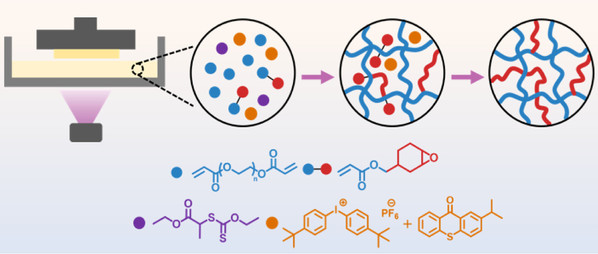
Abstract: The integration of mechanical adaptability and functional versatility in 3D-printed materials remains a central challenge in additive manufacturing. Here, we introduce a photoinduced 3D printing strategy that couples reversible addition–fragmentation chain transfer (RAFT) polymerization with cationic ring-opening polymerization (CROP) in a single resin. Using a dual-functional monomer, 3,4-epoxycyclohexylmethyl acrylate (ECMA), and a bis(4-tert-butylphenyl)iodonium hexafluorophosphate/2-isopropylthioxanthone (Iod/ITX) photoinitiating system, orthogonal polymerizations are triggered under 405 nm light to generate dual-cross-linking networks. The resulting materials exhibit unprecedented mechanical tunability, with Young’s moduli spanning from 8.4 MPa to 2.26 GPa, by varying monomer ratios, RAFT agent content, and postcuring conditions. RAFT-mediated chain ends enable postprinting welding and surface functionalization, while spatial control of radical versus cationic curing yields objects with coexisting soft and rigid domains. This hybrid platform establishes a versatile design principle for mechanically adaptive and multifunctional 3D-printed materials with broad potential in soft robotics, biomimetics, and responsive devices.
Article information: https://doi.org/10.1021/acs.macromol.5c02907