
Target-Responsive Lanthanide Coordination Nanoparticles for Time-Resolved Photoluminescence and SERS Dual-Mode Biosensing
Bing Qi1, Zhao Qi1, Lingling Qiu1, Chenjie Zhang1, Jiayi Chen1, Yurong Wei2,3(隗予荣)*, Jie Wang1(王杰)*, Minmin Xu1(徐敏敏)*
1The Key Lab of Health Chemistry & Molecular Diagnosis of Suzhou, College of Chemistry, Chemical Engineering & Materials Science, Soochow University, Suzhou 215123, China
2School of Chemistry and Life Sciences, Suzhou University of Science and Technology, Suzhou 215009, China
3School of Chemistry and Chemical Engineering, Yangzhou University, Yangzhou 225002, China
Anal. Chem.2025, 97, 49, 27171–27180
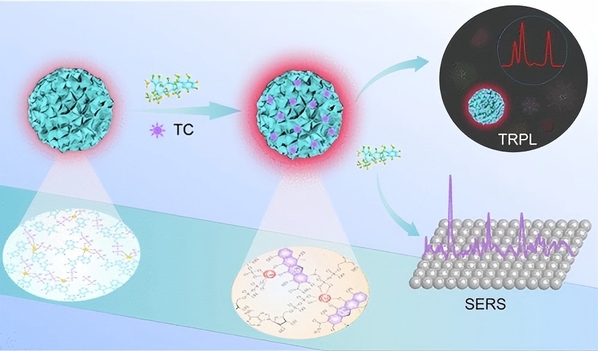
Abstract: Lanthanide coordination nanoparticles (Ln-CNPs) have shown significant potential in optical biosensing. However, the conventional self-assembly of lanthanides and ligands generally produces large cross-linked coordination networks with uncontrollable morphologies and poor dispersibility. In this work, we developed a facile coordination-driven self-assembly strategy for preparing Ln-CNPs with tunable properties, demonstrating their exceptional utility in the dual-mode time-resolved photoluminescence (TRPL)/surface-enhanced Raman spectroscopy (SERS) detection of analytes in complex matrices. Specifically, a series of Ln-CNPs were prepared by the coordination-driven self-assembly of adenosine diphosphate (ADP) with Ln3+. The resulting Ln-CNPs exhibited a controllable morphology, excellent monodispersity, long-lived luminescence, and other functionalities. Notably, the luminescence of ADP-Eu and ADP-Tb CNPs remained detectable even at a delay time of 1 ms, making them ideal for TRPL biosensing; while ADP-Gd CNPs showed potential for magnetic resonance imaging. As a proof-of-concept for optical biosensing applications, we engineered a TRPL/SERS dual-mode platform leveraging the specific response of ADP-Eu CNPs to tetracycline (TC). TC binding to ADP-Eu CNPs induced up to 13-fold TRPL enhancement through the antenna effect, while unbound TC molecules enabled 10–9 M-level SERS detection via plasmonic coupling. Quantitative cross-verification between TRPL and SERS significantly enhanced the determination accuracy. This dual-mode platform achieved 97.64–108.90% recoveries for TC detection in serum samples with <3.2% RSD. Our methodology establishes a generalizable paradigm for engineering multifunctional Ln-CNPs and further opens exciting avenues for the accurate detection of analytes in complex biological systems.
Article information: https://doi.org/10.1021/acs.analchem.5c04697