
Stabilizing and Activating Metastable Nickel Nanocrystals for Highly Efficient Hydrogen Evolution Electrocatalysis
Qi Shao†,#, Yu Wang‡,#, Shize Yang§,∥,#, Kunyan Lu†, Ying Zhang†, Chongyang Tang†, Jia Song†,†Yonggang Feng†, Likun Xiong⊥, Yang Peng⊥, Yafei Li*,‡(李亚飞), Huolin L. Xin∥, and Xiaoqing Huang*,†(黄小青)
†College of Chemistry, Chemical Engineering and Materials Science, Soochow University, Suzhou, Jiangsu 215123, China
‡Jiangsu Collaborative Innovation Centre of Biomedical Functional Materials, School of Chemistry and Materials Science, Nanjing Normal University, Nanjing 210023, China
§Materials Science and Technology Division, Oak Ridge National Laboratory, Oak Ridge, Tennessee 37831, United States
∥Center for Functional Nanomaterials, Brookhaven National Laboratory, Upton, New York 11973, United States
⊥Soochow Institute for Energy and Materials Innovation, College of Physics, Optoelectronics and Energy, Soochow University, Suzhou, Jiangsu 215006,China
#These authors contributed equally.
ACS Nano 2018,12, 11625--11631
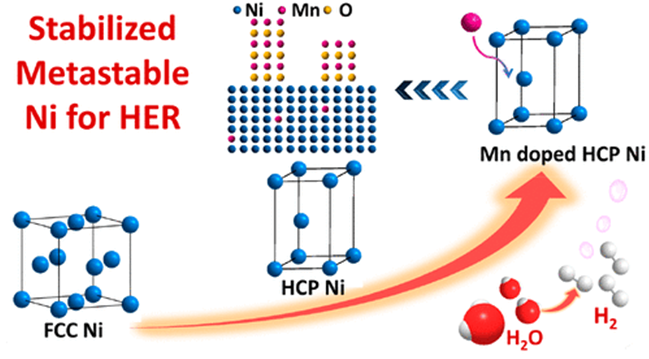
Exploring high-performance and cost-efficient electrocatalysts with unusual metastable phase offers opportunities for improving the electrochemical hydrogen generation, while it remains a great challenge to achieve them with desirable activity and stability. Herein, we report that the doping engineering in a metastable, hexagonal-close-packed nickel (hcp Ni) electrocatalyst is a largely unrevealed yet important factor in achieving an extremely active and stable electrocatalyst toward alkaline hydrogen evolution reaction (HER). Theoretical predications and experimental results suggest that, while the stability of metastable hcp Ni electrocatalyst can be largely improved via the manganese (Mn) doping due to the lower formation energy and lattice stabilization, the MnO/hcp Ni surface promotes the HER via intrinsic favorable H2O adsorption and fast water dissociation kinetics. Consequently, the Mn-doped hcp Ni electrocatalyst shows a small overpotential of 80 mV at 10 mA/cm2 and a low Tafel slope of 68 mV/dec. The result is even approaching that of the commercial Pt/C, being one of the best reported non-noble metal HER electrocatalysts in alkaline media. Under long-term chronopotentiometry measurement, such electrocatalyst can endure at least 10 h with negligible activity decay and structure change. The present work demonstrates the dimension in boosting the electrocatalysis by doping engineering of metastable electrocatalysts.
链接:https://pubs.acs.org/doi/10.1021/acsnano.8b06896