
Uniform mesoporous carbon hollow microspheres imparted with surface-enriched gold nanoparticles enable fast flow adsorption and catalytic reduction of nitrophenols
Mengyuan Zhoua,1, Xiangru Weia,1, Xiangcheng Zhanga, Xingmin Gaoa, Xiaoning Wanga, Winston Duo Wua,*(吴铎), Cordelia Selomulyab, Zhangxiong Wua,b,*(吴张雄)
aSuzhou Key Laboratory of Green Chemical Engineering, School of Chemical and Environmental Engineering, College of Chemistry, Chemical Engineering and Materials Science, Soochow University, Suzhou, Jiangsu 215123, PR China
bDepartment of Chemical Engineering, Monash University, Clayton, VIC 3800, AustraliaChem.
1These authors contributed equally.
Journal of Colloid and Interface Science 537(2019) 112--122
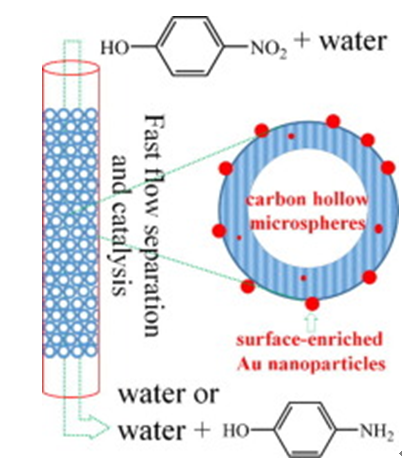
Adsorption and catalytic conversion of nitrophenols (NPs) over carbon-based materials have attracted wide interest. Batch adsorption and catalytic reduction of NPs have been widely reported, but less attention has been paid to flow systems, which require high particle size uniformity and superior active site accessibility. Herein, uniform mesoporous carbon hollow microspheres with their surfaces enriched by Au nanoparticles (denoted as Au@UMCHMs) are synthesized. The surface-enriched Au nanoparticle loading is promoted by the unique feature, that is, relatively dense external layers and mesoporous inner shells, of the carbon microspheres and the simple impregnation-reduction method. The Au@UMCHMs possess uniform sizes of∼82 μm, small shell thickness of∼5.8 μm, high specific surface area (∼1587 m2/g), and uniform mesopores (2.1 and 5.8 nm). They show excellent performance for flow adsorption and catalytic reduction of 4-nitrophenol (4-NP), superior to that of conventional Au-loaded carbon materials. In flow adsorption of 4-NP, the Au@UMCHMs show a fast and complete removal efficiency with high adsorption capacities (∼223 mg/g at breakthrough). They show outstanding performance in flow catalytic reduction of 4-NP. 4-NP with high concentrations (up to 100 mg/L) can be ultrafast and completely catalytically reduced to 4-aminophenol (4-AP) under rapid flow rates (up to∼25 mL/min).
链接:https://www.sciencedirect.com/science/article/pii/S0021979718313110?via%3Dihub