
Self-Doping Fullerene Electrolyte-Based Electron Transport Layer for All-Room-Temperature-Processed High- Performance Flexible Polymer Solar Cells
Jingwen Zhanga, Rongming Xuea, Guiying Xua, Weijie Chena, Guo-Qing Bianb, Changan Wei, Yaowen Li*a(李耀文), and Yongfang Liac
aLaboratory of Advanced Optoelectronic Materials,College of Chemistry Chemical Engineering and Materials Science ,Soochow University,Suzhou 215123, China
bCollege of Chemistry Chemical Engineering and Materials Science,Soochow University,Suzhou 215123, China
cBeijing National Laboratory for Molecular Sciences Institute of Chemistry Chinese Academy of Sciences,Beijing 100190, China
Adv. Funct. Mater.2018,28, 1705847
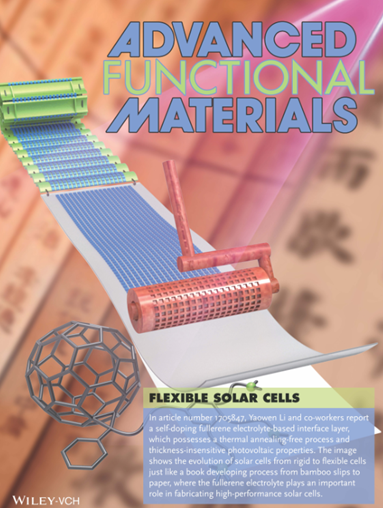
To achieve high‐performance large‐area flexible polymer solar cells (PSCs), one of the challenges is to develop new interface materials that possess a thermal‐annealing‐free process and thickness‐insensitive photovoltaic properties. Here, an n‐type self‐doping fullerene electrolyte, named PCBB‐3N‐3I, is developed as electron transporting layer (ETL) for the application in PSCs. PCBB‐3N‐3I ETL can be processed at room temperature, and shows excellent orthogonal solvent processability,substantially improved conductivity, and appropriate energy levels. PCBB‐3N‐3I ETL alsofunctions as light‐harvesting acceptor in a bilayer solar cell, contributing to the overall device performance. As a result, the PCBB‐3N‐3I ETL‐based inverted PSCs with a PTB7‐Th:PC71BM photoactive layer demonstrate an enhanced power conversion efficiency (PCE) of 10.62% for rigid and 10.04% for flexible devices. Moreover, the device avoids a thermal annealing process and the photovoltaic properties are insensitive to the thickness of PCBB‐3N‐3I ETL, yielding a PCE of 9.32% for the device with thick PCBB‐3N‐3I ETL (61 nm). To the best of one's knowledge, the above performance yields the highest efficiencies for the flexible PSCs and thick ETL‐based PSCs reported so far. Importantly, the flexible PSCs with PCBB‐3N‐3I ETL also show robust bending durability that could pave the way for the future development of high‐performance flexible solar cells.
链接:https://onlinelibrary.wiley.com/doi/abs/10.1002/adfm.201705847