
Radially Aligned Hierarchical Nickel/Nickel–Iron (Oxy)hydroxide Nanotubes for Efficient Electrocatalytic Water Splitting
,, and(耿凤霞)
College of Chemistry, Chemical Engineering and Materials Science,Soochow University,Suzhou215123,China
ACS Appl. Mater. Interfaces,2018,10(10), 8585--8593
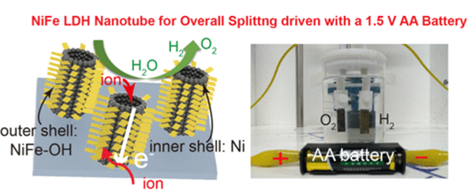
Designing well-controlled hierarchical structures on micrometer and nanometer scales represents one of the most important approaches for upgrading the catalytic abilities of electrocatalysts. Although NiFe (oxy)hydroxide has been widely studied as a water oxidation catalyst due to its high catalytic capability and abundance, its structural manipulation has been greatly restricted due to its inherent crystallographic stacking feature. In this work, we report for the first time the construction of a nanotube structure of NiFe (oxy)hydroxide with an inner Ni-rich layer, which was radially aligned on a macroporous nickel foam. Such a hierarchically structured material realized several crucial factors that are essential for excellent catalytic behaviors, including abundant catalytic sites, a high surface area, efficient ionic and electronic transport, etc., and the designed catalyst exhibited competitive electrocatalytic activity for reaction of not only oxygen evolution but also hydrogen evolution, which is very rare. As a result, this novel material was well-suited for the use as a bifunctional catalyst in an integrated water-splitting electrolyzer, which could be even driven by a single AA battery or a 1.5 V solar cell, outperforming a benchmark catalyst of noble-metal ruthenium–platinum combinations and most state-of-the-art electrocatalysts. The work provided important suggestions for the rational modulation of catalysts with new structures targeted for high-performance electrodes used in electrochemical applications.
链接:https://pubs.acs.org/doi/10.1021/acsami.7b16953