
Folate-Conjugated Polyphosphoester with Reversible Cross-Linkage and Reduction Sensitivity for Drug Delivery
,,,, and(倪沛红)
College of Chemistry, Chemical Engineering and Materials Science, State and Local Joint Engineering Laboratory for Novel Functional Polymeric Materials, Jiangsu Key Laboratory of Advanced Functional Polymer Design and Application, Suzhou Key Laboratory of Macromolecular Design and Precision Synthesis,
ACS Appl. Mater. Interfaces,2018,10(9), 7811--7820
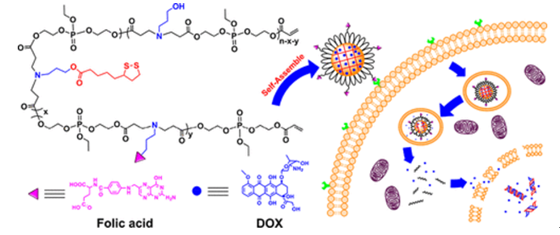
To improve the therapeutic efficacy and circulation stability in vivo, we synthesized a new kind of drug delivery carrier based on folic acid conjugated polyphosphoester via the combined reactions of Michael addition polymerization and esterification. The produced amphiphilic polymer, abbreviated as P(EAEP-AP)-LA-FA, could self-assemble into nanoparticles (NPs) with core-shell structure in water and reversible core cross-linked by lipoyl groups. Using the core cross-linked FA-conjugated nanoparticles (CCL-FA NPs) to encapsulate hydrophobic anticancer drug doxorubicin (DOX), we studied the stability of NPs, in vitro drug release, cellular uptake, and targeting intracellular release compared with both un-cross-linked FA-conjugated nanoparticles (UCL-FA NPs) and core cross-linked nanoparticles without FA conjugation (CCL NPs). The results showed that under the condition of pH 7.4, the DOX-loaded CCL-FA NPs could maintain stable over 72 h, and only a little DOX release (∼15%) was observed. However, under the reductive condition (pH 7.4 containing 10 mM GSH), the disulfide-cross-linked core would be broken up and resulted in 90% of DOX release at the same incubation period. The study of methyl thiazolyl tetrazolium (MTT) assay indicated that the DOX-loaded CCL-FA NPs exhibited higher cytotoxicity (IC50: 0.33 mg L–1) against HeLa cells than the DOX-loaded CCL NPs without FA. These results indicate that the core cross-linked FA-conjugated nanoparticles have unique stability and targetability.
链接:https://pubs.acs.org/doi/10.1021/acsami.7b18887