
Magnetically Bistable Nitrenes: Matrix Isolation of Furoylnitrenes in Both Singlet and Triplet States and Triplet 3-Furylnitrene
Ruijuan Feng†Yan Lu†Guohai Deng†Jian Xu†Zhuang Wu†Hongmin Li†Qian Liu†Norito Kadowaki‡Manabu Abe‡Xiaoqing Zeng*†(曾小庆)
†College of Chemistry, Chemical Engineering and Materials Science,Soochow University, Suzhou 215123,China
‡Department of Chemistry, Graduate School of Science,Hiroshima University, 1-3-1 Kagamiyama, Higashi-Hiroshima, Hiroshima 739-8526,Japan
J. Am. Chem. Soc.,2018,140(1), 10--13
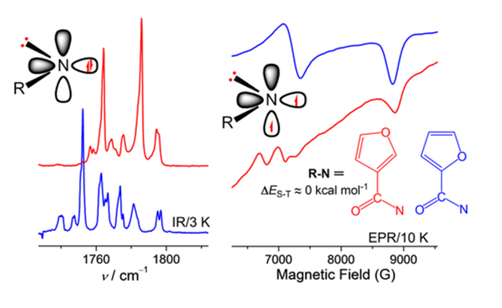
Two simple acylnitrenes, 2-furoylnitrene (2) and 3-furoylnitrene (6), were generated through 266 nm laser photolysis of the corresponding azides. Both are magnetically bistable in cryogenic matrices, as evidenced by the direct observation of the closed-shell singlet state with IR spectroscopy in solid Ne, Ar, Kr, Xe, and N2matrices (3–40 K) and the triplet state in toluene (10 K) with EPR spectroscopy (32: |D/hc| = 1.48 cm–1and |E/hc| = 0.029 cm–1;36: |D/hc| = 1.39 cm–1and |E/hc|c= 0.039 cm–1). Subsequent visible-light and UV laser irradiations led to the formation of furyl isocyanates (3and7) and ring-opening product 3-cyanoacrolein (9-Eand9-Z), respectively, in which the elusive 3-furylnitrene (38) was also identified by IR and EPR spectroscopy (|D/hc| = 1.12 cm–1and |E/hc| = 0.005 cm–1).
链接:https://pubs.acs.org/doi/10.1021/jacs.7b08957