
Laibing Wang Yang Chen Lu Yin Shuangshuang Zhang Nianchen Zhou Wei ZhangXiulin Zhu
a State and Local Joint Engineering Laboratory for Novel Functional Polymeric Materials, Jiangsu Key Laboratory of Advanced Functional Polymer Design and Application, Suzhou Key Laboratory of Macromolecular Design and Precision Synthesis, College of Chemistry, Chemical Engineering and Materials Science, Soochow University, Suzhou 215123, P. R. China
Polym. Chem., 2016,7, 5407-5413
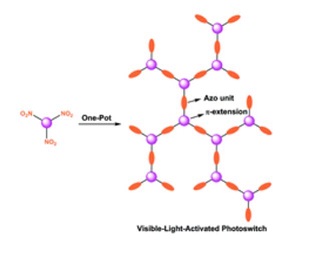
All visible-light-activated Azo photoswitches have recently blossomed. Herein two kinds of photoresponsive Azo hyperbranched polymers, HPTOF and HPTNF, were efficiently synthesized from the respective trinitro-functionalized monomers via combination of the AuNP-catalyzed photocatalytic method and the A3 monomer strategy. The polymerization process showed a very high monomer conversion (>95%) and a perfect selectivity. The molecular weights of the obtained Azo hyperbranched polymers were much higher than those of linear systems as reported previously, which could be efficiently adjusted by controlling the dosages of the mononitro-compound (the end-capping reagent) employed in the polymerization system. The resulting Azo hyperbranched polymers were well characterized by using GPC, NMR, FT-IR and UV-vis spectra. From unusual to common Azo-polymers, the π–π* absorptions in the UV-vis spectra show significant red-shifts; therefore the photoisomerizations of these Azo-polymers (HPTOF and HPTNF) can be induced by visible light. Interestingly, HPTOF and HPTNF demonstrated a double-wavelength (532 nm green light and 313 nm UV light) light-responsive Z → E photoisomerization. The relatively lower photoswitching ability of HPTNF than that of HPTOF was attributed to the partial overlap of π–π* (Z-isomer) and n–π* (E-isomer) transitions resulting from its much longer extending π-conjugation structure.
链接:http://pubs.rsc.org/en/Content/ArticleLanding/2016/PY/c6py01232a#!divAbstract