
Yi-Shi Dong Xin-Hong Xiong Xiao-Wen Lu Zhao-Qiang WuHong Chen
State and Local Joint Engineering Laboratory for Novel Functional Polymeric Materials, College of Chemistry, Chemical Engineering and Materials Science, Soochow University, 199 Ren-ai Road, Suzhou 215123, P. R. China
J. Mater. Chem. B, 2016,4, 6111-6116
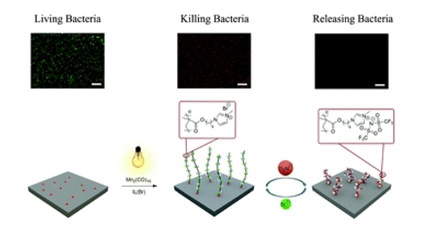
The development of a smart antibacterial surface that can both kill attached live bacteria and release dead bacteria is reported. The surface consists of counterion-responsive poly(cationic liquid) brushes of poly(1-(2-methacryloyloxyhexyl)-3-methylimidazolium bromide) (PIL(Br)), the properties of which can be switched repeatedly between bacterial killing and bacterial release. Upon counter-anion exchange of PIL(Br) chains using lithium bis(trifluoromethanesulfonyl) amide (LiTf2N) to yield PIL(Tf2N), the wettability of the surface changes from hydrophilic (water contact angle ∼52°) to hydrophobic (∼97°). The PIL(Br) chains adopt an extended conformation with bactericidal properties. Counter-anion switching to PIL(Tf2N) gives a collapsed chain conformation allowing the release of killed bacteria. The switchable killing and releasing actions of the surface were maintained over three cycles. Thus it is concluded that PIL(Br) layers provide a viable approach for the fabrication of “smart” antibacterial surfaces.
链接:http://pubs.rsc.org/en/content/articlelanding/2016/tb/c6tb01464j#!divAbstract