
†, †, †(邓超), †, ‡, and †(钟志远)
† Biomedical Polymers Laboratory, College of Chemistry, Chemical Engineering and Materials Science, Soochow University, Suzhou, 215123, China
‡ State Key Laboratory of Molecular Engineering of Polymers, Fudan University, Shanghai 200433, China
ACS Appl. Mater. Interfaces, 2016, 8 (33), pp 21155–21162
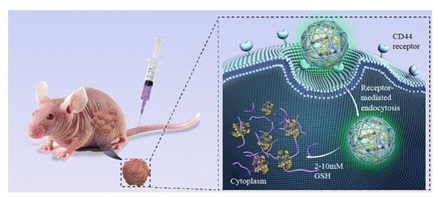
In spite of their high specificity and potency, few protein therapeutics are applied in clinical cancer therapy owing to a lack of safe and efficacious delivery systems. Here, we report that redox-sensitive and intrinsically fluorescent photoclick hyaluronic acid nanogels (HA-NGs) show highly efficient loading and breast tumor-targeted delivery of cytochrome c (CC). HA-NGs were obtained from hyaluronic acid-graft-oligo(ethylene glycol)-tetrazole (HA-OEG-Tet) via inverse nanoprecipitation and catalyst-free photoclick cross-linking with l-cystine dimethacrylamide (MA-Cys-MA). HA-NGs exhibited a superb CC loading content of up to 40.6 wt %, intrinsic fluorescence (λem = 510 nm), and a small size of ca. 170 nm. Notably, CC-loaded nanogels (CC-NGs) showed a fast glutathione-responsive protein release behavior. Importantly, released CC maintained its bioactivity. MTT assays revealed that CC-NGs were highly potent with a low IC50 of 3.07 μM to CD44+ MCF-7 human breast tumor cells. Confocal microscopy observed efficient and selective internalization of fluorescent HA-NGs into MCF-7 cells. Interestingly, HA-NGs exhibited also effective breast tumor penetration. The therapeutic results demonstrated that CC-NGs effectively inhibited the growth of MCF-7 breast tumor xenografts at a particularly low dose of 80 or 160 nmol CC equiv./kg. Moreover, CC-NGs did not cause any change in mice body weight, corroborating their low systemic side effects. Redox-sensitive and intrinsically fluorescent photoclick hyaluronic acid nanogels have appeared as a “smart” protein delivery nanoplatform enabling safe, efficacious, traceable, and targeted cancer protein therapy in vivo.
链接:http://pubs.acs.org/doi/abs/10.1021/acsami.6b05775