
a State and Local Joint Engineering Laboratory for Novel Functional Polymeric Materials, College of Chemistry, Chemical Engineering and Materials Science, Soochow University, Suzhou 215123, People's Republic of China
b State Key Laboratory of Organometallic Chemistry, Shanghai Institute of Organic Chemistry, Chinese Academy of Sciences, Shanghai 200032, People's Republic of China
c Department of Chemistry, University of Sheffield, Brook Hill, Sheffield S3 7HF, UK
Inorg. Chem. Front., 2016,3, 1297-1305
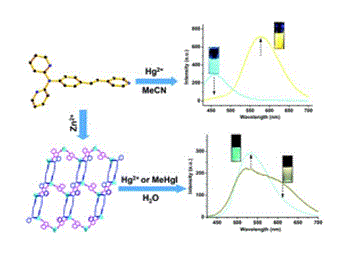
Solvothermal reaction of Zn(NO3)2·6H2O with di-pyridin-2-yl-[4-(2-pyridin-4-yl-vinyl)-phenyl]-amine (ppvppa) and 1,4-naphthalenedicarboxylic acid (1,4-H2NDC) in H2O and MeCN at 150 °C yielded a two-dimensional (2D) coordination Zn(II) polymer [Zn(ppvppa)(1,4-NDC)]n (1). Compound 1 was characterized by elemental analysis, IR spectroscopy, powder X-ray diffraction, single-crystal X-ray diffraction and thermogravimetric analysis. Compound 1 consists of dimeric [Zn2(ppvppa)2] units linked by 1,4-NDC bridges to generate a 2D honeycomb network. Either compound 1 or ppvppa alone can detect Hg2+ or MeHgI selectively and with good sensitivity. Upon addition of Hg2+ ions to a MeCN solution of ppvppa, marked changes in the UV-vis and fluorescence spectra are observed, associated with colour changes, which are easily identified by the naked eye. The pyridinyl rings of ppvppa are coordinated to the Hg2+ ion. This motif in the presence of NO3− ions forms a binuclear complex [Hg2(ppvppa)2(NO3)4] (2), which has been characterized as the solvate [Hg2(ppvppa)2(NO3)4]·H2O·4MeCN (2·H2O·4MeCN) by single-crystal X-ray diffraction studies. In aqueous solution, compound 1 emits pale orange light at ambient temperature and the addition of Hg2+ or MeHgI induces an change of fluorescence color from pale orange to blue. Compound 1 is a promising candidate as a sensitive naked-eye indicator for Hg2+ or MeHgI in water under a UV lamp.
Prof. Lang and Prof. Brammer met with each other in Nanjing, China when Prof. Brammer taught lectures at Nanjing Tech University last November. Prof. Lang's research involves metal sulfide cluster chemistry, design and development of new coordination complex-based catalysts, bioinorganic chemistry related to mimicking metal sites of enzymes and proteins, and so on. Prof. Brammer's research interest covers supramolecular chemistry and crystal engineering, in particular host–guest chemistry and catalysis in metal–organic frameworks, reactions in molecular solids and fundamentals of intermolecular interactions. Both professors recognised their many mutual research interests and decided to initiate an international collaborative project in the area of coordination polymers. Both will visit the partner's lab in China and UK in the near future and expand this project to a higher level.
链接:http://xueshu.baidu.com/s?wd=paperuri%3A%2821b238ec9a15f132b4c9f9c48fe7ecc2%29&filter=sc_long_sign&tn=SE_xueshusource_2kduw22v&sc_vurl=http%3A%2F%2Fpubs.rsc.org%2Fen%2Fcontent%2Farticlepdf%2F2016%2Fqi%2Fc6qi00160b&ie=utf-8&sc_us=18306304205916439593