
†, †, ‡, §, and † (黄小青)
† College of Chemistry, Chemical Engineering and Materials Science, Soochow University, Jiangsu, 215123, China
‡ Department of Materials Science and Engineering, College of Engineering, Peking University, Beijing 100871, China
§ Testing and Analysis Center, Soochow University, Jiangsu, 215123, China
Nano Lett., 2016, 16 (7), pp 4424–4430
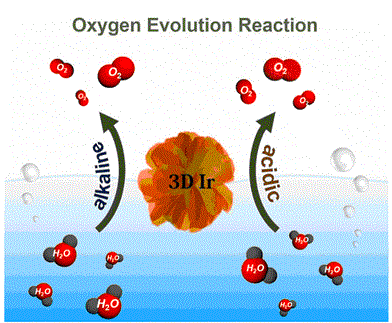
Shape-controlled noble metal nanocrystals (NCs), such as Au, Ag, Pt, Pd, Ru, and Rh are of great success due to their new and enhanced properties and applications in chemical conversion, fuel cells, and sensors, but the realization of shape control of Ir NCs for achieving enhanced electrocatalysis remains a significant challenge. Herein, we report an efficient solution method for a new class of three-dimensional (3D) Ir superstructure that consists of ultrathin Ir nanosheets as subunits. Electrochemical studies show that it delivers the excellent electrocatalytic activity toward oxygen evolution reaction (OER) in alkaline condition with an onset potential at 1.43 V versus reversible hydrogen electrode (RHE) and a very low Tafel slope of 32.7 mV decade–1. In particular, it even shows superior performance for OER in acidic solutions with the low onset overpotential of 1.45 V versus RHE and small Tafel slope of 40.8 mV decade–1, which are much better than those of small Ir nanoparticles (NPs). The 3D Ir superstructures also exhibit good stability under acidic condition with the potential shift of less than 20 mV after 8 h i-t test. The present work highlights the importance of tuning 3D structures of Ir NCs for enhancing OER performance.
链接:http://pubs.acs.org/doi/abs/10.1021/acs.nanolett.6b01554