
, , , , , and (戴洁)
College of Chemistry, Chemical Engineering and Materials Science, Soochow University, Suzhou 215123, P. R. China
Inorg. Chem., 2016, 55 (13), pp 6496–6503
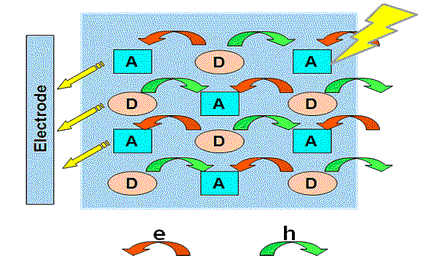
A systematic study on ligand-to-ligand charge-transfer (LLCT) properties of three closely related metal–organic frameworks (MOFs) is presented. These compounds are formulated as [MnL(4,4′-bpy)(H2O)]n·nCH3CN (1), [MnL(bpe)0.5(DMF)]n·2nH2O (2), and [MnL(bpa)(H2O)]n·2nH2O (3) (L = dimethylthio-tetrathiafulvalene-bicarboxylate, 4,4′-bpy = 4,4′-bipyridine, bpe = 1,2-bis(4-pyridyl)ethene, bpa = 1,2-bis(4-pyridyl)ethane). The X-ray single-crystal diffractions show that complexes 1–3 are all two-dimensional (2-D) coordination polymers with different frameworks in crystal lattices. Charge-transfer (CT) interactions within these MOFs are visually apparent in colors and vary according to the conjugated states of the bipyridine ligands (4,4′-bpy, bpe, and bpa). Theoretical calculations show that the charge transfer occurs from ligand L to bipyridine. The intensity of the LLCT is in the order of 2 > 1 > 3 investigated by theoretical calculations and ESR, which indicates that the intensity of CT is related to the bipyridyl conjugated state. Photocurrent responses of these compounds are consequently studied, and the results are in agreement with the intensity of charge transfer and linearly related to the LLCT energy.
链接:http://pubs.acs.org/doi/abs/10.1021/acs.inorgchem.6b00571