
Construction of dual-functional polymer nanomaterials with near-infrared fluorescence imaging and polymer prodrug by RAFT-mediated aqueous dispersion polymerization
Chun Tian‡a,Jinyun Niu‡b, Xuerui Wei b,Yujie Xu*b(许玉杰), Lifen Zhang*a(张丽芬), Zhenping Cheng *a(程振平) and Xiulin Zhua,c
a Suzhou Key Laboratory of Macromolecular Design and Precision Synthesis, Jiangsu Key Laboratory of Advanced Functional Polymer Design and Application, Department of Polymer Science and Engineering, College of Chemistry, Chemical Engineering and Materials Science, Soochow University, Suzhou 215123, China.
b State Key Laboratory of Radiation Medicine and Protection, School of Radiation Medicine and Protection and Collaborative Innovation Center of Radiation Medicine of Jiangsu Higher Education Institutions, Soochow University, Suzhou 215123, China.
c Global Institute of Soft Technology, No. 5 Qingshan Road, Suzhou National Hi-TechDistrict, Suzhou 215163, China
‡These authors contributed equally to this work.
Nanoscale, 2018, 10, 10277--10287
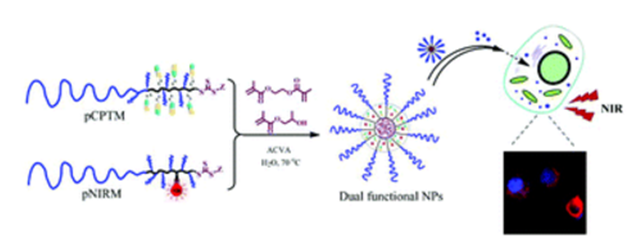
The performance of functional polymer nanomaterials is a vigorously discussed topic in polymer science. We devoted ourselves to investigating polymer nanomaterials based on near-infrared (NIR) fluorescence imaging and polymer prodrug in this study. Aza-boron dipyrromethene (BODIPY) is an important organic dye, having characteristics such as environmental resistance, light resistance, high molar extinction coefficient, and fluorescence quantum yield. We incorporated it into our target monomer, which can be polymerized without changing its parent structure in a polar solvent and copolymerized with water-soluble monomer to improve the solubility of the dye in an aqueous solution. At the same time, the hydrophobic drug camptothecin (CPT) was designed as a prodrug monomer, and the polymeric nanoparticles (NPs) with NIR fluorescence imaging and prodrug were synthesizedin situin reversible addition–fragmentation chain transfer (RAFT)-mediated aqueous dispersion polymerization. The dynamic light scattering (DLS) and transmission electron microscopy (TEM) revealed the final uniform size of the dual-functional polymeric NPs morphology. The dual-functional polymeric NPs had a strong absorption and emission signal in the NIR region (>650 nm) based on the fluorescence tests. In consideration of the long-term biological toxicity, confocal laser scanning microscopy (CLSM) results indicated that the dual-functional NPs with controlled drug content exhibited effective capability of killing HeLa cells. In addition,in vivoimaging of the dual-functional NPs was observed in real time, and the fluorescent signals clearly demonstrated the dynamic process of prodrug transfer.
链接:http://pubs.rsc.org/en/Content/ArticleLanding/2018/NR/C8NR00930A#!divAbstract