
Multifunctional gold nanoparticle layers for controllable capture and release of proteins
Zhenhua Li, Feng Liu, Yuqi Yuan, Jingxian Wu, Hongwei Wang*(王宏炜), Lin Yuan *(袁琳) and Hong Chen
State and Local Joint Engineering Laboratory for Novel Functional Polymeric
Materials, College of Chemistry, Chemical Engineering and Materials Science, Soochow University, 199 Ren’ai Road, Suzhou 215123, P. R. China.
Nanoscale, 2017, 9, 15407--15415
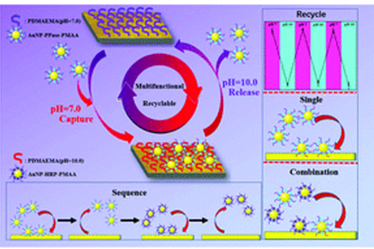
Protein modified functional surfaces have been applied extensively in the field of biomaterials and medicine. Regulation of the amount and activity of proteins on the material surface is always a challenge and a key research issue. A multifunctional micro/nano-composite based surface system for efficient controllable capture and release of proteins is proposed and studied in the present paper. This novel system contains (1) gold nanoparticles (AuNPs) co-modified with an enzyme and poly(methacrylic acid) (PMAA), e.g., AuNP-pyrophosphatase (PPase)-PMAA, as nanostructured protein carriers; (2) gold nanoparticle layers (GNPLs) modified with poly(2-(dimethylamino)ethyl methacrylate) (PDMAEMA), i.e., GNPL-PDMAEMA, as a micro/nano-structured support platform for surface bioactivity regulation. The capture–release of proteins and the regulation of surface bioactivity in this composite surface system were investigated under different conditions. The results showed that the proposed system is capable of protein capture and release with simple adjustment of the pH value from neutral pH to basic pH. When the pH of the system is stabilized at 7.0, the GNPL-PDMAEMA surface could adsorb plenty of AuNP-PPase-PMAA conjugates and maximum surface bioactivity occurred, but when the pH of the system is adjusted to 10.0, the GNPL-PDMAEMA surface could liberate almost all the AuNP-PPase-PMAA conjugates and thus surface bioactivity disappeared. Meanwhile, by cyclical variations between pH 7.0 and pH 10.0, this surface protein capture/release system could realize recycling and reuse of one certain protein multiple times, a series of proteins acting sequentially in accordance with pre-designed procedures, and a functional combination of multiple proteins. This recyclable multifunctional surface with the capability of protein capture/release has great potential in many applications, such as biomonitoring and biomolecule immobilization.
链接:http://pubs.rsc.org/en/content/articlelanding/2017/nr/c7nr05276f#!divAbstract