
Elastic Lattice and Excess Charge Carrier Manipulation in 1D–3D Perovskite Solar Cells for Exceptionally Long-Term Operational Stability
Yu Zhan1, Fu Yang1, Weijie Chen1, Haiyang Chen1, Yunxiu Shen1, Yaowen Li1,2, *(李耀文), and Yongfang Li1,3
1 Laboratory of Advanced Optoelectronic Materials,Suzhou Key Laboratory of Novel Semiconductor-optoelectronics Materials and Devices,College of Chemistry,Chemical Engineering and Materials Science Soochow University,Suzhou 215123, China
2 State and Local Joint Engineering Laboratory for Novel Functional Polymeric Materials,College of Chemistry,Chemical Engineering and Materials Science,Soochow University,Suzhou 215123, China
3 Beijing National Laboratory for Molecular Sciences,Institute of Chemistry,Chinese Academy of Sciences,Beijing 100190, China
Adv. Mater. 2021, 2105170
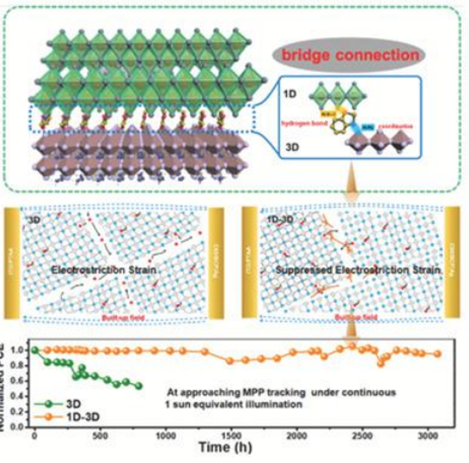
3D organic–inorganic hybrid halide perovskite solar cells (pero-SCs) inherently face severe instability issue due to ion migration under operational conditions. This ion migration inevitably results from the decomposition of ionic bonds under lattice strain and is accelerated by the existence of excess charge carriers. In this study, a 1D–3D mixed-dimensional perovskite material is explored by adding an organic salt with a bulk benzimidazole cation (Bn+). The Bn+ can induce 3D perovskite crystalline growth with the preferred orientation and form a 1D BnPbI3 perovskite spatially distributed in the 3D perovskite film. For the first time, the electro-strictive response, which has a significant influence on the lattice strain under an electric field, is observed in polycrystalline perovskite. The 1D–3D perovskite can effectively suppress electro-strictive responses and unbalanced charge carrier extraction, providing an intrinsically stable lattice with enhanced ionic bonds and fewer excess charge carriers. As a result, the ion migration behavior of the p-i-n 1D–3D based pero-SC is dramatically suppressed under operational conditions, showing ultra-long-term stability that retains 95.3% of its initial power conversion efficiency (PCE) under operation for 3072 h, and simultaneously achieving an excellent PCE with a hysteresis-free photovoltaic behavior.
链接:https://onlinelibrary.wiley.com/doi/full/10.1002/adma.202105170