
Exceeding 14% Efficiency for Solution-Processed Tandem Organic Solar Cells Combining Fullerene- and Nonfullerene-Based Subcells with Complementary Absorption
†, †, ‡, †∥(国霞), #, †(张茂杰), #, †⊥, and ∥
†Laboratory of Advanced Optoelectronic Materials, College of Chemistry, Chemical Engineering and Materials Science, Soochow University, Suzhou 215123, China
‡School of Science, Guangdong University of Petrochemical Technology, Maoming 525000, China
∥Institute of Molecular Functional Materials and Department of Applied Biology and Chemical Technology, The Hong Kong Polytechnic University, Hung Hom, Hong Kong, China
#Beijing National Laboratory for Molecular Sciences, State Key Laboratory of Polymer Physics and Chemistry, Institute of Chemistry, Chinese Academy of Sciences, Beijing 100190, China
⊥CAS Research/Education Center for Excellence in Molecular Sciences, CAS Key Laboratory of Organic Solids, Institute of Chemistry, Chinese Academy of Sciences, Beijing 100190, China
These authors contributed equally to this work.
ACS Energy Lett., 2018, 3 (10), 2566--2572
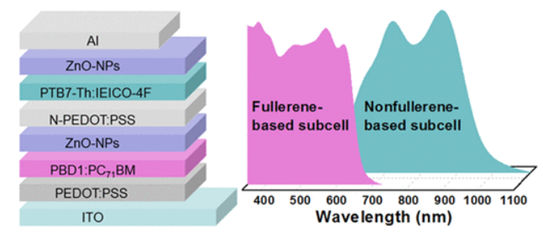
For a highly efficient tandem organic solar cell, it is important for the subcells to minimize the absorption overlap and generate high and balanced currents. Considering the strong absorption and high external quantum efficiency at the short wavelength, developing a highly efficient blend system with a wide-bandgap (WBG) polymer as the donor and a fullerene derivative as the acceptor in the front cell would be an effective strategy. However, it is a challenge to obtain a high short-current density (Jsc) for this blend system. Here, we develop a WBG polymer (PBD1) with an optical bandgap of 1.88 eV. The PBD1:PC71BM blend system with a thickness of 230 nm achieves a power conversion efficiency (PCE) of 9.8% with a high Jsc of 14.6 mA cm–2. When tandem devices are fabricated with PBD1:PC71BM in the front cell, a PCE of 14.2% with a high Jsc of 12.3 mA cm–2 is achieved.
链接:https://pubs.acs.org/doi/10.1021/acsenergylett.8b01448