
Positive Aging Effect of ZnO Nanoparticles Induced by Surface Stabilization
Wenjuan Zhang1, Xingtong Chen1, Yuhui Ma2, Zhiwei Xu1, Longjia Wu3, Yixing Yang3, Sai-Wing Tsang2*, and Song Chen1*(陈崧)
1College of Chemistry, Chemical Engineering and Materials Science, Soochow University, Suzhou, Jiangsu 215123, China
2Department of Materials Science and Engineering, City University of Hong Kong(香港城市大学), Hong Kong SAR, China
3TCL Research, Shenzhen, Guangdong 518067, China
J. Phys. Chem. Lett.2020, 11, 5863--5870
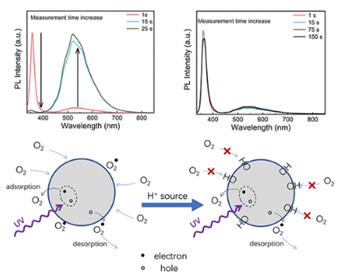
For quantum-dot photodiodes comprising an electron-transporting layer assembled of ZnO nanoparticles, the light emitter/absorber generally exhibits enhanced optoelectronic performance after the device is shelf-aged. To understand the so-called positive aging effect, the optoelectronic properties of ZnO nanoparticles are investigated at the thin film and device level as a function of aging time. It is evidenced that the aging process is driven by a surface-stabilizing mechanism of ZnO nanoparticles, in which the active surface adsorption sites for oxygen are gradually but irreversibly stabilized, i.e.. with surface termination of HO-ZnO, leading to reduced nonradiative recombination and increased built-in potential in the adjacent photoactive layer. This work provides insight into new synthetic routes for minimizing the negative impact caused by the aging process.
链接:https://pubs.acs.org/doi/10.1021/acs.jpclett.0c01640