
Efficient reduction of Cr(VI) by a BMO/Bi2S3 heterojunction via synergistic adsorption and photocatalysis under visible light
Xueqing Li, Dongyun Chen*(陈冬赟), Najun Li, Qingfeng Xu, Hua Li, Jinghui He, Jianmei Lu*(路建美)
College of Chemistry, Chemical Engineering and Materials Science, Collaborative Innovation Center of Suzhou Nano Science and Technology, Soochow University, Suzhou, Jiangsu, 215123, China
Journal of Hazardous Materials 400 (2020) 123243
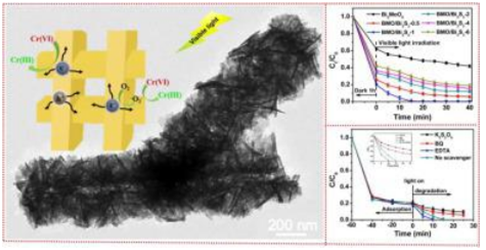
The development of efficient visible light driven photocatalyst is the premise of the progress of photocatalytic technology. In this paper, a well-designed orthorhombic Bi2MoO6/Bi2S3 (BMO/Bi2S3) composite was obtained by a two-step fabrication route. Using MoO3 nanobelt as a sacrificial template, BMO nanosheet-based framework was prepared by refluxing process. Through anion exchange reaction of the synthesized BMO to introduce Bi2S3 nanosheets, and BMO/Bi2S3 heterojunction was successfully constructed. Simultaneously, the Bi2S3 loading percentage of BMO/Bi2S3 was controlled by tuning the anion exchange time. The intimate interfacial contact between the BMO framework and Bi2S3 nanosheets endows the nanocomposites with high adsorption and photocatalytic removal of Cr(VI). Photocatalytic tests show that BMO/Bi2S3-1 composite possess the highest activity with 100 % removal rate of Cr(VI) in 15 min. The dramatically enhanced adsorption and photocatalytic capacity of BMO/Bi2S3 photocatalysts can be ascribed to the frame structure, large surface area and numerous nanochannels. In addition, the BMO/Bi2S3 photocatalyst is highly stable during the reaction and can be used repeatedly. These features indicate that the BMO/Bi2S3 composite could be used for environmental remediation and wastewater treatment.
链接:https://www.sciencedirect.com/science/article/pii/S0304389420312322