
Design and evaluation a kind of functional biomaterial for bone tissue engineering: Selenium/mesoporous bioactive glass nanospheres
Meng Hu a,1 , Jie Fang b,1 , Ying Zhang a, *(张英), Xiang Wang a , Wenxing Zhong a , Zhufa Zhou a, *(周竹发)
a College of Chemistry, Chemical Engineering and Materials Science, Soochow University, Suzhou 215123, People’s Republic of China
b College of Pharmaceutical Sciences, Soochow University, Suzhou 215123, People’s Republic of China
Journal of Colloid and Interface Science 579 (2020) 654--666
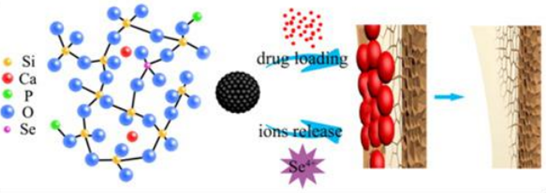
Conventional treatments of bone tumor involve removal followed by radiation and chemotherapeutic drugs that may have limitations and cause secondary damage. The development of functional filling biomaterial has led to a new strategy for tumor therapy. In this study, a novel therapeutic ion selenium doped mesoporous bioactive glasses (Se/MBG) nanospheres were successfully synthesized by a facile sol–gel technique using cetyl trimethyl ammonium bromide (CTAB) as the template, which had uniform spherical morphology (≈ 400 nm), high surface area (>400 m2/g) and mesopore volume (≈0.30 cm3/g). Results showed that hydroxyapatite formation ability and controllable doxorubicin (DOX) release and distinct degradation of Se/MBG nanospheres depended on the dose of Se4+. In vitro cell cultures showed that both Se/MBG and DOX-Se/MBG nanospheres had the culture time and dose dependent cytotoxicity to MG63 osteosarcoma cells. But DOX-Se/MBG nanospheres reduced the acute cytotoxicity to MG63 because of the co-operative effect of Se and DOX. Meanwhile, Se/MBG nanospheres were found to have selective cytotoxicity to cancer cells (MG63) and normal cells (MC3T3-E1), indicating that the prepared Se/MBG nanospheres had cell recognition function. These all note that the synthesized Se/MBG nanospheres can be used as a filling biomaterial for the bone tissue engineering.
链接:https://www.sciencedirect.com/science/article/pii/S0021979720308730