
Iron-doped NiCo-MOF hollow nanospheres for enhanced electrocatalytic oxygen evolution
Cong Li‡a,b, Xing-Jia Li‡a, Zhong-Yin Zhao a, Fei-Long Li*c(李飞龙), Jiang-Yan Xue a, Zheng Niu*a(牛政), Hong-Wei Gu a, Pierre Braunstein d and Jian-Ping Lang *a,b(郎建平)
aCollege of Chemistry, Chemical Engineering and Materials Science, Soochow University, Suzhou 215123, Jiangsu, People’s Republic of China
bState Key Laboratory of Organometallic Chemistry, Shanghai Institute of Organic Chemistry, Chinese Academy of Sciences, Shanghai 200032, People’s Republic of China
cSchool of Materials Engineering, Changshu Institute of Technology, Changshu 215500, People’s Republic of China
dInstitut de Chimie (UMR 7177 CNRS), Université de Strasbourg, 4 rue Blaise Pascal -CS 90032, 67081 Strasbourg, France
‡These authors contributed equally to this work and should be considered cofirst authors.
Nanoscale, 2020, 12, 14004--14010
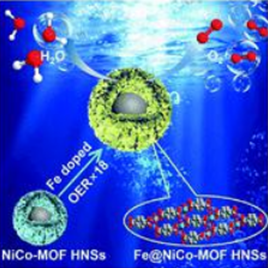
The development of metal–organic frameworks (MOFs) as high-efficiency electrocatalysts for water splitting has attracted special attention due to their unique structural features including high porosity, large surface areas, high concentrations of active sites, uniform pore sizes and shapes, etc. Most of the related reports focus on the in situ generation of high-efficiency electrocatalysts by annealed MOFs. However, the pyrolysis process usually destroys the porous structure of MOFs and reduces the number of active sites due to the absence of organic ligands and agglomeration of metal centers. In this work, we prepared unique NiCo-MOF hollow nanospheres (NiCo-MOF HNSs) by a solvothermal method and further fabricated Fe-doped NiCo-MOF HNSs (Fe@NiCo-MOF HNSs) by a simple impregnation-drying method. Significant enhancement of electrocatalytic activity of Fe@NiCo-MOF HNSs was witnessed because of the doped Fe. Compared with the parent NiCo-MOF HNSs, the optimized Fe@NiCo-MOF HNSs exhibited a lower overpotential of 244 mV at 10 mA·cm−2 with a smaller Tafel slope of 48.61 mV·dec−1, which was lowered by ca. 90 mV due to the influence of Fe doping on the electronic structure of the active centers of Ni and Co. The above materials also displayed excellent stability without obvious activity decay for at least 16 hours. These findings present a new entry in the design and fabrication of high-efficiency MOF-based electrocatalysts for energy conversion.
链接:https://pubs.rsc.org/en/content/articlelanding/2020/nr/d0nr01218a#!divAbstract