
Hierarchical branchedplatinum–copper tripods ashighly active and stable catalysts
Hui Xu,aPingpingSong,aFeiGao,aYukihideShiraishib and Yukou Du *a,b(杜玉扣)
a College of Chemistry, Chemical Engineering and Materials Science, Soochow University, Suzhou 215123, PR China
b Tokyo University of Science Yamaguchi, Sanyo-Onoda-shi, Yamaguchi 756-0884,Japan
Nanoscale 2018, 10, 8246--8256
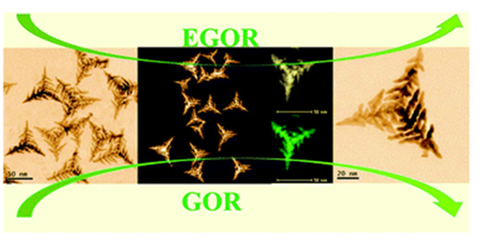
Designing and manipulating the structure of nanomaterials can efficiently tailor their catalytic properties,enabling the promotion of both their activity and stability. We herein report the shape-controlled synthesisof advanced Pt–Cu hierarchical tripod nanocrystals (HTNCs) by controlling the amount of KI andreaction time. The as-prepared nanocrystals (NCs) look like a typical tripod on the whole, consisting ofsimilar branch structural units. In addition, the structure of the HTNCs could also be obtained with anarrow Pt/Cu feeding ratio. Owing to the unique HTNC structure and exposed high-index facets, as wellas probable electronic effects between Cu and Pt, the as-obtained Pt–Cu HTNCs can exhibit greatlyenhanced electrocatalytic activity toward ethylene glycol oxidation reaction (EGOR) and glycerol oxidation (GOR), which are 5.1 and 6.5 times higher in mass activity, as well as 5.6 and 7.3 times higher inspecific activity relative to commercial Pt/C, showing that they are a class of promising electrocatalyst forfuel cells. This work presents huge opportunities for optimizing the electrocatalytic oxidation reaction bydesigning the structure of nanocatalysts.
链接:http://pubs.rsc.org/en/content/articlelanding/2018/nr/c8nr01962b#!divAbstract