
Thermoresponsive Memory Behavior in Metallosupramolecular Polymer-Based Ternary Memory Devices
†††††‡‡*††*†
†College of Chemistry, Chemical Engineering, and Materials Science, Collaborative Innovation Center of Suzhou Nano Science and Technology, National Center for International Research, and ‡Institute of Functional Nano & Soft Materials Laboratory and Jiangsu Key Laboratory for Carbon-Based Functional Materials, Soochow University, Suzhou 215123, P. R. China
ACS Appl. Mater. Interfaces, 2017, 9 (38), 32930--32938
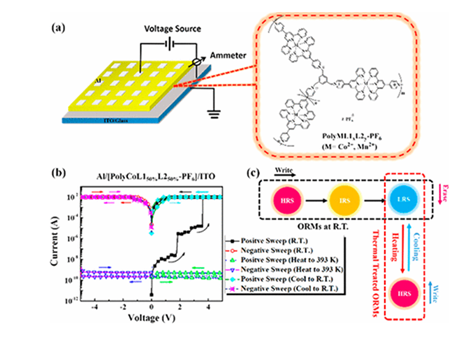
Thermal-sensitive materials, such as metallosupramolecular polymers, have been integrated into devices for a broad range of applications. However, the role of these materials is limited to temperature sensing and the lack of a memory function. Herein, we present novel [PolyCo-L1xL2y-PF6]-based organic resistive memories (ORMs) possessing both a thermal response and ternary memory behavior with three electrical resistance states [high (HRS), intermediate (IRS), and low (LRS)]. Furthermore, the thermal behavior can be memorized by the Al/[PolyCoL1xL2y-PF6]/indium–tin oxide devices. Heating and cooling the devices at a LRS results in a switch from the LRS to a HRS and further to a LRS, indicating that the thermal behavior can be efficiently memorized. Following the heating and cooling process, devices at a HRS retain their ternary memory behavior, while an unstable resistance variation behavior is observed at the IRS. We propose a possible mechanism for the thermoresponsive memory behavior, and this finding provides a guide for the design of future thermoresponsive ORMs.
链接:http://pubs.acs.org/doi/10.1021/acsami.7b09132