
A novel catalyst for efficient electrooxidation of ethanol enabled by 3D open-structured PdCu nanocages
Ping’er Yu a , Hui Xu a , Liujun Jin a , Chunyan Chen a , Hongyuan Shang a , Qingyun Liu b, *(刘青云) , Yukou Du a, *(杜玉扣)
a College of Chemistry, Chemical Engineering and Materials Science, Soochow University, Suzhou 215123, PR China
b College of Chemical and Environmental Engineering, Shandong University of Science and Technology, Qingdao 266590, PR China
Journal of Colloid and Interface Science 555 (2019) 195--202
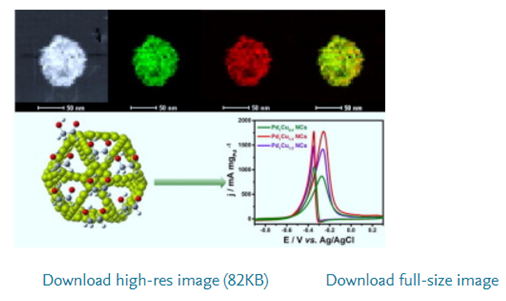
Mastery over the structure at nanoscale can efficiently tune the catalytic properties of catalysts, enabling great enhancement in electrocatalytic performance toward liquid fuel electrooxidation reactions. Herein, we demonstrate a facile one-pot method for the successful fabrication of binary PdCu nanocatalysts bounded with 3D open-structured nanocages, which show the advantages of high surface areas, facile mass/electron transport, and strong synergistic effect. Impressively, the resultant 3D open-structured PdCu nanocages (NCs) show large promotion in electrocatalytic performance toward ethanol oxidation reaction (EOR) with the mass activity of 1790.8 mA mg−1, being 3.3 times higher than that of commercial Pd/C (536.2 mA mg−1). Besides, the specific activity for EOR on PdCu NCs (7.7 mA cm−2) is also comparable to many Pt-based electrocatalysts, suggesting the dramatically improved electrocatalytic activity. The outstanding electrocatalytic performance of binary PdCu catalysts is attributed to the highly open 3D nanocage structure and strong electronic effect of Pd and Cu.
链接:https://www.sciencedirect.com/science/article/pii/S0021979719308732?via%3Dihub#!