
Light-triggered evolution of molecular clusters toward sub-nanoscale heterojunctions with high interface density
Chaozhuang Xue a, Jiaxu Zhang a, Xiang Wang a, Meng Gu b, Yuanmin Zhu bc, Dong-Sheng Li d, Jun Guo e, Yang Liu f and Tao Wu *a(吴涛)
a College of Chemistry, Chemical Engineering and Materials Science, Soochow University, Suzhou 215123, China.
b Department of Materials Science and Engineering, Southern University of Science and Technology, Shenzhen 518055, China
c Academy for Advanced Interdisciplinary Studies, Southern University of Science and Technology, Shenzhen 518055, China
d College of Materials and Chemical Engineering, Hubei Provincial Collaborative Innovation Center for New Energy Microgrid, Key Laboratory of Inorganic Nonmetallic Crystalline and Energy Conversion Materials, China Three Gorges University, Yichang 443002, China
e Testing & Analysis Center, Soochow University, Suzhou 215123, China f Key Lab of Bioorganic Phosphorus Chemistry and Chemical Biology, Department of Chemistry, Tsinghua University, Beijing 100084, China
Chem. Commun., 2019, 55, 8146--8149
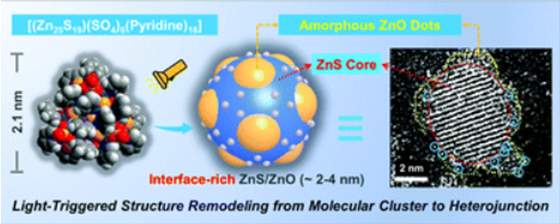
Herein, we report a simple, yet highly effective approach for constructing a new type of sub-nanoscale ZnS/ZnO heterojunction (∼2–4 nm) with highly rich interfaces by photoetching hybrid Zn–S–O molecular clusters. The obtained ZnS/ZnO heterojunctions with ZnS spheres decorated with ultrasmall amorphous ZnO dots exhibit superior photocatalytic performance (∼94.0 μmol g−1 h−1), compared to nanoscale homologous samples obtained via conventional heat treatment (∼17.0–21.4 μmol g−1 h−1). Such a light-triggered molecular-cluster-to-heterojunction strategy provides a synthetic approach to building other sub-nanoscale hetero-structured materials for further promoting the catalytic-related applications.
链接:https://pubs.rsc.org/en/content/articlelanding/2019/CC/C9CC03873F#!divAbstract