

Controlled Ring-Opening Polymerization of gem-Dialkyl β-Lactams toward Melt-Processable and Chemically Recyclable Nylon-3 Polyamides
Shucheng Ding, Xin Wang(王鑫)*, Zhengbiao Zhang(张正彪)*
College of Chemistry, Chemical Engineering and Materials Science, Soochow University, Suzhou 215123, China
Macromolecules 2026, 59, 9796-9806
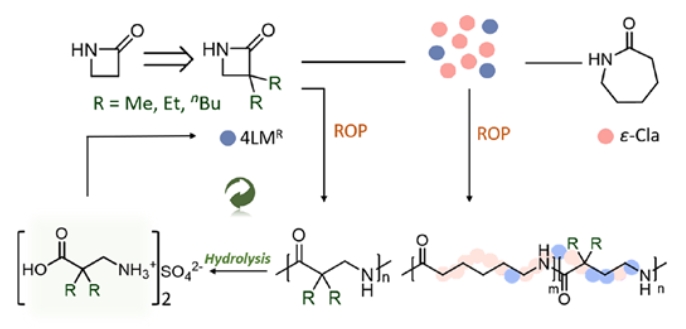
Abstract:Aliphatic polyamides are indispensable engineering materials, yet the development of chemically recyclable variants remains challenging due to their strong interchain hydrogen bonding and high crystallinity. Here, we report a monomer design strategy based on α-gem-dialkyl β-lactams that enables the controlled synthesis of nylon-3 polyamides with tunable properties and closed-loop chemical recyclability. Organocatalytic ring-opening polymerization of these monomers proceeds in a living manner at ambient temperature, affording well-defined polyamides with predictable molecular weights and narrow dispersities (Đ < 1.4). Systematic variation of the α-alkyl substituents from methyl to butyl allows precise modulation of interchain interactions, yielding polymers with melting transitions ranging from 200 to 275 °C, lying below their decomposition temperatures, and static water contact angles from 28 to 97°. This structural modification not only enables viable melt processing but also facilitates efficient closed-loop recycling through acid-catalyzed hydrolysis followed by intramolecular cyclization to regenerate the pristine β-lactam monomers. Furthermore, copolymerization with ε-caprolactam significantly reduces the hygroscopicity of commodity nylon 6. By simultaneously addressing the trade-offs among polymerization control, melt processability, property tunability, and chemical recyclability, this work establishes a versatile platform for the design of high-performance, sustainable polyamide materials.
Article information: https://doi.org/10.1021/acs.macromol.6c01612
