

Interlayer Metal-Ligand Coordination in Covalent Organic Frameworks: A Structural Strategy for Enhanced Nitrate Reduction Electrocatalysis
Mingqing Shan1, Jinhao Guo1, Zhixin Zhang1, Jie Zhou1, Lin Li1, Longyu Cheng1, Xiuyang Zou(邹修洋)2*, Siyu Guo(郭思宇)1*
1College of Chemistry, Chemical Engineering and Materials Science, Soochow University, Suzhou, People’s Republic of China
2Jiangsu Engineering ResearchCenter of Environmental Functional Materials, School of Chemistry and Chemical Engineering, Huaiyin Normal University, Huai’an, People’s Republic of China
Adv. Funct. Mater.2026,36,e78097
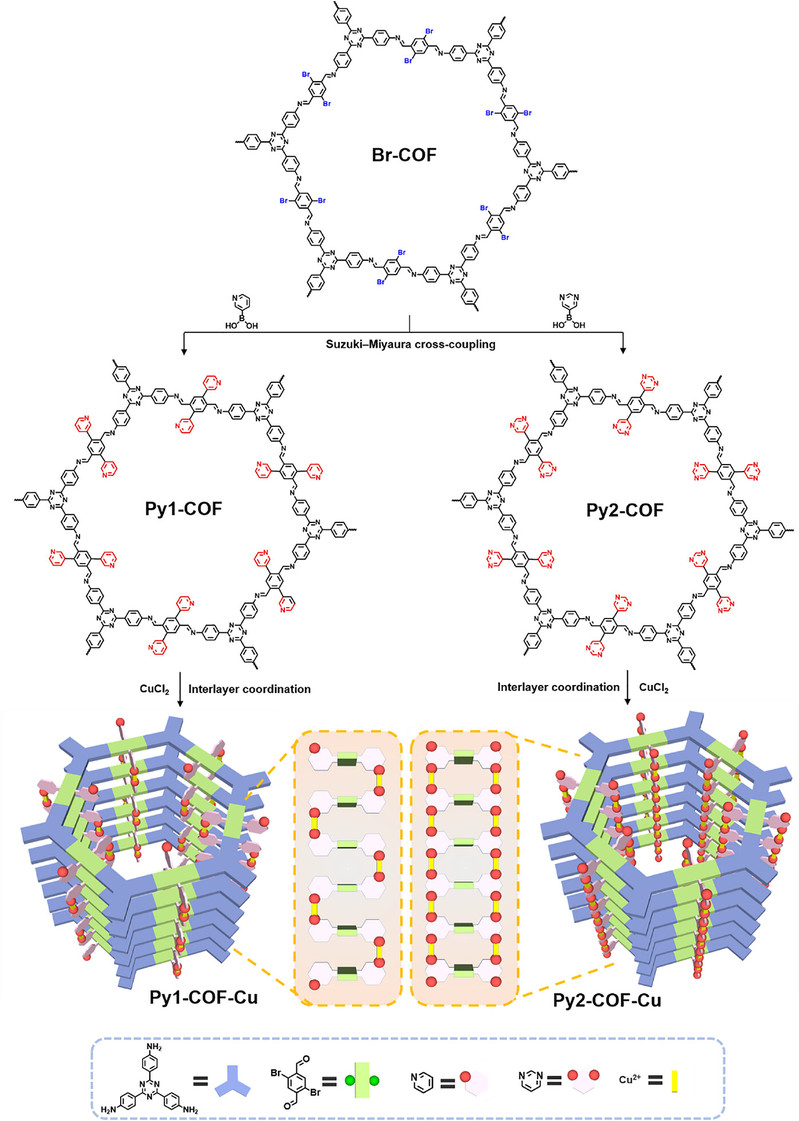
Abstract: Efficient multielectron electrocatalysis in layered covalent organic frameworks (COFs) is frequently limited by weak cross-plane charge delivery to pore-confined active sites. Herein, we report the construction of two metal-bridged COFs (Py1-COF-Cu and Py2-COF-Cu) by incorporating nitrogen-containing heterocycles to facilitate interlayer Cu-N coordination. This design generates continuous linear coordination chains within the 1D channels while maintaining high intrinsic porosity. Synchrotron XANES confirms the Cu-N coordination environment, and DFT reveals realigned frontier-orbital energetics together with pronounced redistribution of electron density along the interlayer direction. Among them, the optimized Py2-COF-Cu serves as a highly active cathode catalyst for the electroreduction of nitrate to ammonia in neutral media. It delivers a maximum Faradaic efficiency of 87.8% and a peak NH3 yield rate of 4964.6 µmol h-1 mg-1 at -1.0 V vs. RHE, comparable to leading Cu-based NO3RR catalysts. This interlayer coordination motif provides a structural lever to couple ordered porosity with effective cross-plane charge transport for demanding multielectron reactions.
Article information: https://doi.org/10.1002/adfm.78097
