

Core-Shell MIL-101(Fe)@NiCo-LDH Nanocubes for the Electrocatalytic Oxygen Evolution Reaction
Zhongjie Song1, Yuhao Wang1, Nannan Zhang1, Jun Yu1, Zhengying Wu(吴正颖)2* , Yukou Du(杜玉扣)1*
1College of Chemistry, Chemical Engineering and Materials Science, Soochow University, Suzhou 215123, China
2Jiangsu Key Laboratory for Environment Functional Materials, School of Materials Science and Engineering, Suzhou University of Science and Technology, Suzhou 215009, China
Inorg. Chem. 2026, 65, 20631-20641
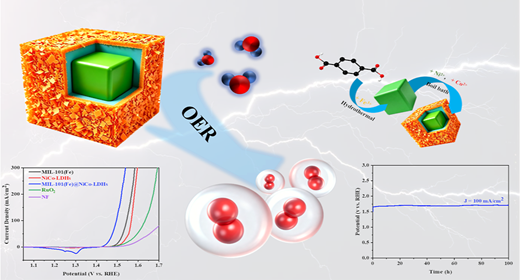
Abstract:The development of highly efficient oxygen evolution reaction (OER) electrode materials has attracted widespread attention. In this work, we prepared MIL-101(Fe) using the traditional hydrothermal and oil bath method to coat a layer of NiCo-LDH (nickel cobalt layered double hydroxide (LDH)) on its surface, forming an MOF (metal-organic framework)/LDH heterostructure. The core-shell heterostructure and synergistic effect among Co, Ni, and Fe atoms give the catalyst an excellent OER catalytic performance. Specifically, it requires overpotentials of 216 and 247 mV to reach current densities of 10 and 50 mA·cm-2, respectively. Chronopotentiometry shows that it can maintain a current density of 100 mA·cm-2 for over 100 h. In overall water-splitting tests, it only requires an applied voltage of 1.52 V to reach 10 mA·cm-2 and exhibits stability for over 100 h at 100 mA·cm-2. Furthermore, this work identified 3 h as the optimal oil bath time and revealed that the synergistic coupling of MOF and LDH facilitates the shift of the OER mechanism to the LOM (lattice oxygen mechanism) pathway. This work ingeniously constructs a material with a core–shell structure, realizing performance enhancement through the synergistic effects among multiple metals and making a beneficial contribution to promote the development of green hydrogen production.
Article information: https://doi.org/10.1021/acs.inorgchem.6c03462
