

In Situ Activating a Protein-Complexed Quenched Probe via Alkaline Phosphatase Response for Pyroptosis-Mediated Cancer Immunotherapy
Jiangtao Geng1, Jie Sun1, Ling-Hong Xiong2, Fulong Ma1, Yinzhe Chen3, Qian Zhang3,Ben Zhong Tang4, Xuewen He1(何学文)*
1State Key Laboratory of Bioinspired Interfacial Materials Science, The Key Lab of Health Chemistry and Molecular Diagnosis of Suzhou, College of Chemistry,Chemical Engineering and Materials Science, Soochow University, Suzhou, China
2School of Public Health, Suzhou Medical College of Soochow University,Soochow University, Suzhou, China
3Department of Chemistry and Materials Science, School of Science, Xi’an Jiaotong-Liverpool University, Suzhou, China
4Guangdong Basic Research Center of Excellence for Aggregate Science, School of Science and Engineering, The Chinese University of Hong Kong (Shenzhen),Shenzhen, China
Angew. Chem. Int. Ed. 2026, 65, e8976820
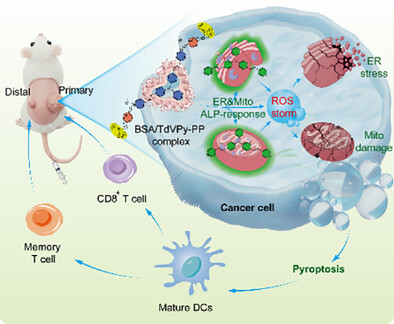
Abstract: In situ synthesis of therapeutic agents and activation of immune effect within tumor cells are highly desired for precision cancer theranostics. Intracellular reaction and aggregation triggered by tumor-specific biomarkers represent a potent strategy to activate therapeutics and modulate immune responses. Here, we designed a protein-complexed quenched probe that specifically and sensitively responded to the abnormally overexpressed biomarker alkaline phosphatase (ALP) in tumors, enabling in situ activation to induce cell pyroptosis and immunoactivation. Compared to its monophosphate analog (TdVPy-P), the diphosphate probe (TdVPy-PP) demonstrated faster ALP responsiveness and stronger fluorescence output with a fourfold increase in signal-to-noise ratio, enabling specific targeting and aggregation on subcellular organelle membranes (mitochondria and endoplasmic reticulum). This process further boosted localized ROS generation and activated GSDME-mediated pyroptosis, leading to the release of immunogenic antigens that promoted dendritic cell maturation and toxic T cell activation. After complexation with protein, TdVPy-PP can be administered via tail vein injection to target and fluorescently visualize tumor tissue. The growth of primary, distant, and metastatic tumors was significantly suppressed through in situ activated chemodynamic/photodynamic effects combined with systemic immune activation, all while maintaining excellent biocompatibility. This protein-assisted in situ activation strategy offers a promising tool for precise and efficient tumor therapy.
Article information: https://doi.org/10.1002/anie.8976820
