

Conventional versus three-state helicity in chiral copolymers: Reversal dynamics and programmable chiroptical switches
Xiaoxiao Cheng (程笑笑)1,3, Zeyu Tang1, Zixiang He1, Zhenyang Zhou1, Li-Li Han2, Zhan-Wei Li (李占伟)2, Wei Zhang (张伟)1,2
1State and Local Joint Engineering Laboratory for Novel Functional Polymeric Materials, Jiangsu Engineering Laboratory of Novel Functional Polymeric Materials, Suzhou Key Laboratory of Macromolecular Design and Precision Synthesis, College of Chemistry, Chemical Engineering and Materials Science, Soochow University, Suzhou 215123, China
2College of Chemistry, Zhengzhou University, Zhengzhou 450001, China
3WPI Nano Life Science Institute (WPI-NanoLSI), Kanazawa University, Kakuma-machi, Kanazawa 920-1192, Japan
Chem,2026,12,102988
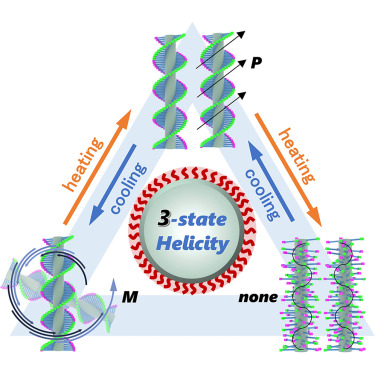
Abstract: Here, we report the thermo-driven three-state helicity of amphiphilic copolymer (BCP) nanoassemblies in ethanol. These nanoassemblies are prepared by polymerization-induced chiral self-assembly, with core-shell structures containing a solvophilic poly(methacrylic acid) stabilizer and a solvophobic poly(methacrylate) core bearing chiral azobenzene (Azo) mesogens. Within the aggregated Azo core, the competition between the single intra-chain helix and the high-order superstacks formed by densely aggregated backbones enables the nanoassemblies to exhibit three types of chiroptical properties over a wide temperature range. Three helical states can be reversibly switched over multiple cycles. The helical transition dynamics were elucidated through solvent dissociation experiments, spectroscopic analyses, and a theoretical framework combining a cholesteric hard-core model with the exciton chirality theory. By regulating environmental stimuli and azobenzene isomerization, seven chiroptical switches with reversible responses were engineered for different scenarios.
Article information: https://doi.org/10.1016/j.chempr.2026.102988
