

Helicity-Driven Enhancement of Antifreeze Activity in Structurally Simple Bioinspired N-Substituted Polypeptides
Xuehua Deng1, Shuwang Wu2, Ning Zhao3,4, Sunting Xuan(宣孙婷)1*, Zhengbiao Zhang(张正彪)1,2*
1College of Chemistry, Chemical Engineering and Materials Science, Soochow University, Suzhou, China
2State Key Laboratory of Radiation Medicine and Protection, Soochow University, Suzhou, China
3College of Pharmaceutical Sciences, Soochow University, Suzhou, China
4Leherna Therapeutics, Suzhou,China
Adv. Funct. Mater., 2026, 36, e77089
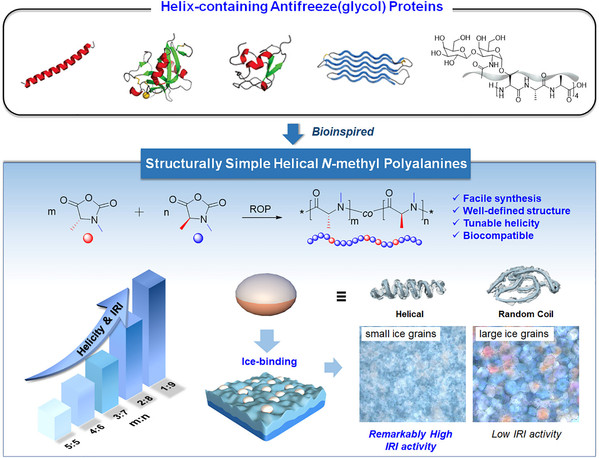
Abstract: Cryoprotective agents (CPA) play a pivotal role in mitigating ice recrystallization (IR) damage, which is a key challenge in cryopreservation of biological samples. Current limitations in understanding CPA's structural determinants have greatly hindered their development. Current synthetic CPAs require high molecular weights and/or complex structures to achieve effective IR inhibition. Inspired by helical antifreeze (glycol) proteins, the structurally simplest N-substituted polypeptides, N-methyl polyalanines (PNMAs), with well-defined structures and varying degrees of helicity were synthesized by controlled ring-opening polymerization (ROP). Intriguingly, the IR inhibition of PNMAs exhibited a strong correlation with helicity. PNMAs with high helicity exhibited remarkable IR inhibition at low concentrations (< 1 mg/mL), matching top-performing polymers. Surprisingly, even short-chain PNMA showed superior IRI activity over synthetic polymers of similar chain lengths. The helical structure of PNMA is critical to promote its preferential binding to ice planes and suppress ice crystal growth, as revealed by the ice-shaping and ice-affinity experiments. Besides, PNMAs showed low cytotoxicity/hemolysis and high efficacy in cryopreservation of cells and protein therapeutics. This work highlights bioinspired N-substituted polypeptides as a promising new generation of highly efficient and biocompatible CPAs, offering structural insights for advanced cryoprotectant design.
Article information: https://doi.org/10.1002/adfm.77089
