

Photocatalytic 1,6-HAT-Enabled Formal [3+3] Annulation of Vinyl Azides with α-Bromomalonates to Tetrahydropyridines
Wen-Jun Li1,2, Li-Fa Zhong1,2, Limin Yang(杨丽敏)3*, Weidong Rao4, Shu-Su Shen5, DaoPeng Sheng6,7, Gang Wang8, Kai Liu8, Zhao-Ying Yang(杨钊英)1,2*, Shun-Yi Wang(汪顺义)1,2*
1Key Laboratory of Organic Synthesis of Jiangsu Province, College of Chemistry, Chemical Engineering and Materials Science, Soochow University, Suzhou 215123, China
2Collaborative Innovation Center of Suzhou Nano Science and Technology, Soochow University, Suzhou 215123, China
3College of Materials, Chemistry and Chemical Engineering, Hangzhou Normal University, Hangzhou 311123, Zhejiang, P. R. China
4Key Laboratory of Biomass-based Green Fuels and Chemicals, College of Chemical Engineering, Nanjing Forestry University, Nanjing 210037, China
5School of Environmental Science and Engineering, Suzhou University of Science and Technology, Suzhou 215009, P. R. China
6State Key Laboratory of Radiation Medicine and Protection, School for Radiological and Interdisciplinary Sciences (RAD-X), Soochow University, Suzhou, Jiangsu 215123, China
7Collaborative Innovation Center of Radiation Medicine of Jiangsu Higher Education Institutions, Soochow University, Suzhou, Jiangsu 215123, China
8Jiangsu Changqing Agrochemical Co., Ltd., No. 8 Sanjiang Road, Jiangdu Economic Development Zone, Yangzhou 225215, Jiangsu, China
Org. Lett.2026, 28, 10051-10056
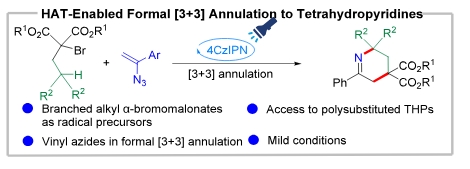
Abstract: A visible-light-induced formal [3+3] annulation of vinyl azides with branched alkyl-substituted α-bromomalonates is reported for the synthesis of polysubstituted 2,3,4,5-tetrahydropyridines. Photocatalytic generation of a carbon-centered radical, followed by addition to the vinyl azide and N2 extrusion, affords an iminyl radical that undergoes 1,6-HAT and cyclization. The reaction proceeds under mild conditions, exhibits broad substrate compatibility, and is amenable to gram-scale synthesis. Hydrogenation of the products provides highly substituted piperidines, demonstrating the synthetic utility of the method.
Article information: https://doi.org/10.1021/acs.orglett.6c02806
