

Surface Reconstruction for Stable Monolithic All-Inorganic Perovskite/Organic Tandem Solar Cells with over 21% Efficiency
Weijie Chen1, Dong Li2, Xu Chen3, Haiyang Chen1, Shuo Liu1, Haidi Yang1, Xinqi Li1,Yunxiu Shen1, Xuemei Ou1, Yang (Michael) Yang3, Lin Jiang2, Yaowen Li1,*(李耀文), and Yongfang Li1,4
1 Laboratory of Advanced Optoelectronic Materials,Suzhou Key Laboratory of Novel Semiconductor-optoelectronics Materials and Devices,College of Chemistry,Chemical Engineering and Materials Science,Soochow University,Suzhou 215123, China
2 Institute of Functional Nano and Soft Materials (FUNSOM),Jiangsu Key Laboratory for Carbon-Based Functional Materials & Devices,Soochow University,Suzhou 215123, China
3 State Key Laboratory of Modern Optical Instrumentation,College of Optical Science and Engineering International Research Center for Advanced Photonics,Zhejiang University,Hangzhou, Zhejiang 310058, China
4 Beijing National Laboratory for Molecular Sciences,Institute of Chemistry Chinese Academy of Sciences,Beijing 100190, China
Adv. Funct. Mater. 2021, 2109321
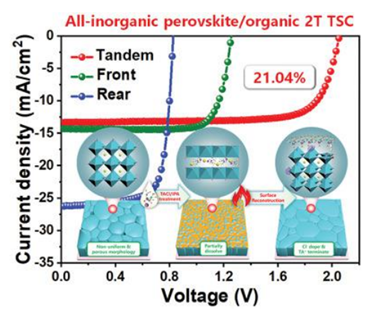
The construction of monolithic two-terminal tandem solar cells (2T TSCs) offers the possibility of pursuing high power conversion efficiency (PCE) by overcoming the single-junction Shockley–Queisser limit in photovoltaics. However, little attention is paid to simultaneously improve the stability by utilizing the complementary properties of various photoactive layers. Here, beyond the stacked photoactive layers featuring complementary absorption, all-inorganic perovskite (CsPbI1.8Br1.2) is chosen as the photoactive layer of the front wide-bandgap subcell for its intrinsic high thermal stability and ultraviolet (UV)-filtering function to address the burn-in and UV degradation of organic rear subcells. To realize their monolithic integration, the charge recombination efficiency in the interconnecting layer (ICL) between the two types of subcells is tentatively improved by surface reconstruction of all-inorganic perovskite using trimethylammonium chloride. The repaired CsPbI1.8Br1.2 surface enables effective suppression of nonradiative recombination and facilitates hole transport, providing efficient charge recombination in the ICL in the 2T TSC. As a result, the all-inorganic perovskite/organic 2T TSC delivers a promising PCE of 21.04%, accompanied by an ultrahigh open-circuit voltage (Voc) of 2.05 V, which is nearly equal to the superposition of the respective Voc values of the subcells. More importantly, the 2T TSC simultaneously shows outstanding operational and UV stabilities.
链接:https://onlinelibrary.wiley.com/doi/full/10.1002/adfm.202109321
