

One-Source Strategy Boosting Dopant-Free Hole Transporting Layers for Highly Efficient and Stable CsPbI2Br Perovskite Solar Cells
Xinqi Li1, Weijie Chen1, Shuhui Wang1, Guiying Xu1, Shuo Liu1, Yaowen Li1,*(李耀文), and Yongfang Li1,2
1 Laboratory of Advanced Optoelectronic Materials,College of Chemistry,Chemical Engineering and Materials Science,Soochow University,Suzhou 215123, China
2 Beijing National Laboratory for Molecular Sciences,Institute of Chemistry,Chinese Academy of Sciences,Beijing 100190, China
Adv. Funct. Mater. 2021, 2010696
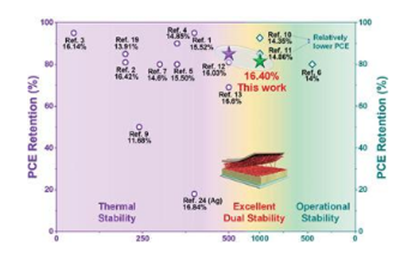
All-inorganic perovskites have emerged as promising photovoltaic materials due to their superior thermal stability compared to their organic–inorganic hybrid counterparts. However, the inferior film quality and doped hole transport layer (HTL) have a strong tendency to degrade the perovskite under high temperatures or harsh operating conditions. To solve these problems, a one-source strategy using the same polymer donor material (PDM) to simultaneously dope CsPbI2Br perovskite films via antisolvent engineering and fabricating the HTL is proposed. The doping assists perovskite film growth and forms a top–down gradient distribution, generating CsPbI2Br with enlarged grain size and reduced defect density. The PDM as the HTL suppresses the energy barrier and forms favorable electrical contacts for hole extraction, and assemble into a fingerprint-like morphology that improves the conductivity, facilitating the creation of a dopant-free HTL. Based on this one-source strategy using PBDB-T as PDM, the CsPbI2Br perovskite solar cell with a dopant-free HTL achieves a power conversion efficiency (PCE) of 16.40%, which is one of the highest PCEs reported among all-inorganic CsPbI2Br pero-SCs with a dopant-free HTL. Importantly, the devices exhibit the highest thermal stability at 85 °C and operational stability under continuous illumination even with Ag as the top electrode and present good universality.
链接:https://onlinelibrary.wiley.com/doi/full/10.1002/adfm.202010696
